Best 50 Pint Dehumidifiers: Top 9 Picks (November 2026)
The best 50 pint dehumidifiers include the hOmeLabs Dehumidifier for pump drainage and Wi-Fi, the hOmeLabs Dehumidifier for large homes with Wi-Fi, and the AEOCKY 5500 Sq.Ft Energy Star Most Efficient for very damp basements.
On this page (4 sections)
The best 50 pint dehumidifier depends on your room, humidity and drain access. If you are weighing a room unit against a larger system, read whole-house vs portable dehumidifiers.
Start with where moisture gathers in your home. A basement corner, a laundry room and a closed bedroom can need different airflow even when they share the same floor area.
Note how damp the space feels across the day. Morning condensation, musty corners and slow drying clothes can point to a steady moisture source.
Check the drain first, because drainage shapes daily use. A low floor drain suits a gravity hose, while a drain across the room may suit a pump.
Think about tank emptying at the same time. A small tank is fine for a room you pass often but a chore for a basement you visit a few times each week.
The hOmeLabs pump model is the clearest fit when you want remote control and water moved to a drain. Other picks offer higher stated daily capacities under warmer, more humid conditions.
That difference matters for comparison. A model rated at 80°F and 60% RH is not directly comparable with one rated at 95°F and 90% RH, even if the pint numbers look close.
A pint rating is a comparison point, not a promise for every room. Always check the temperature and humidity conditions alongside daily capacity.
Also weigh controls before you decide. A timer, a clear humidity readout and preset modes can make steady use easier in a room you do not check each day.
Placement can also limit results in a divided home. Closed doors and separate floors can stop dry air from reaching the spot that needs it most.
If you're still deciding which dehumidifier to buy, start with room size, typical dampness and drain access. For a smaller room, see our best 35 pint dehumidifier picks.
Use those three facts to build a shortlist. Room size narrows the class, dampness narrows capacity, and drain access narrows the model type.
Finally, plan for the filter and tank from the start. A washable filter needs periodic cleaning, and a tank needs emptying if you do not connect drainage.
Our picks at a glance
-
1

-
2

-
3
 Best for very damp basements
AEOCKY 5500 Sq.Ft Energy Star Most Efficient
9.6/10 our score
See it on Amazon
- 4
 Best for wide humidity settingsCheck it
- 5
 Check it
yaufey 80 Pint Dehumidifier for Basement
Best for flexible room settings - 6
 Best for laundry room dryingCheck it
- 7
 Check it
Waykar 80 Pints 2025 Energy Star Dehumidifier
Best for cooler basements - 8
 Check it
AEOCKY 5000Sq.Ft Energy Star Version 6.0 Dehumidifier
Best for efficient large rooms - 9
 Check it
Wellsle 3500 Sq.Ft Dehumidifier
Best for quiet bedrooms
How we chose these 50 pint dehumidifiers
We compared stated moisture capacity, the conditions behind it, coverage claims, controls and drainage options. The score reflects how well those features match shoppers who need a household dehumidifier for a damp room or larger area.
Capacity figures need context. hOmeLabs rates its 50-pint models at 80°F and 60% RH, Wellsle rates its model at 90°F and 80% RH, and several higher-capacity models use 95°F and 90% or 95% RH conditions.
Those conditions are not a footnote. Warmer air holds more moisture, and a high pint figure at 95°F can look larger than one earned in a cooler room.
Coverage claims also need care. Stated coverage assumes a fairly open space, and walls, ceilings and closed doors can change how far dry air travels.
We treated coverage as a guide rather than a guarantee. A unit listed for a large area may still suit a smaller damp room.
Controls shaped the comparison because they affect daily use. Modes, timers, humidity targets and fan speeds decide how easily you can match the unit to laundry, sleep or a basement routine.
Drainage received the same weight. A pump, a gravity hose and a tank each create a different routine depending on where water can leave the room.
We also looked at movable design, since casters, handles and weight matter when one unit needs to serve several rooms in turn. Filter care entered the review as a practical point, since a washable filter works well only if you clean it on schedule.
Noise claims were noted in context. A low decibel figure helps in a bedroom, but room surfaces and fan speed still shape the sound you notice.
A higher daily pint figure does not guarantee a better fit either, since tank size affects how often you empty water. Price and ratings were left out of the scoring logic described here.
The focus stayed on stated features, stated conditions and how those features map to a real room. That approach keeps the choice grounded, so you can read each pick for its rating conditions and drainage method.
| Product | Best for | Daily capacity | Drainage | Stated coverage | Our score |
|---|---|---|---|---|---|
| hOmeLabs Dehumidifier | pump drainage and Wi-Fi | 50 pints at 80°F, 60% RH | Built-in pump and continuous drain | Up to 7,500 sq ft | 9.6 |
| hOmeLabs Dehumidifier | large homes with Wi-Fi | 50 pints at 80°F, 60% RH | Continuous drain outlet, hose not included | Up to 7,000 sq ft | 9.6 |
| AEOCKY 5500 Sq.Ft Energy Star Most Efficient | very damp basements | 80 pints at 95°F, 95% RH | Drain hose included | Up to 5,500 sq ft | 9.6 |
| Waykar 80 Pints 5000 Sq. Ft | wide humidity settings | 80 pints at 95°F, 90% RH | Gravity drain hose included | Up to 5,000 sq ft | 9.5 |
| yaufey 80 Pint Dehumidifier for Basement | flexible room settings | 80 pints at 95°F, 90% RH | Tank or included gravity drain hose | Up to 5,500 sq ft | 9.4 |
| Aiusevo 52 Pint Dehumidifier | laundry room drying | 52 pints at 95°F, 90% RH | Tank or included drain hose | Up to 5,000 sq ft | 8.3 |
| Waykar 80 Pints 2025 Energy Star Dehumidifier | cooler basements | 80 pints at 95°F, 90% RH | Tank or included drain hose | Up to 5,000 sq ft | 7.6 |
| AEOCKY 5000Sq.Ft Energy Star Version 6.0 Dehumidifier | efficient large rooms | 74 pints at 95°F, 95% RH | Drain hose included | Up to 5,000 sq ft | 7.5 |
| Wellsle 3500 Sq.Ft Dehumidifier | quiet bedrooms | 50 pints at 90°F, 80% RH | Continuous drain hose included | Up to 3,500 sq ft | 7.4 |
Which best 50 pint dehumidifier fits your room?
These picks range from 50-pint models to higher-capacity units, so choose by room conditions and drainage needs instead of the headline number alone. Each one suits a different balance of controls, drainage convenience and stated coverage.
Read the rating conditions with each model. Then match the fit to your dampness level, drain route and room layout.
hOmeLabs Dehumidifier: Best for pump drainage and Wi-Fi
- 50 pints per day at 80°F, 60% RH
- Built-in pump
- Wi-Fi control
- Up to 7,500 sq ft stated coverage
A built-in pump and Wi-Fi control suit a large room where you want remote settings and less manual bucket emptying.
Pros
- Built-in pump
- Wi-Fi control
- Comfort, Turbo and Continuous modes
Cons
- 1.6-gallon tank
- Hose setup is needed for continuous drainage
The hOmeLabs model with a built-in pump is the clearest fit if the unit needs to send water to a drain that isn’t directly below it. It removes up to 50 pints per day at 80°F and 60% RH, and hOmeLabs gives a maximum figure of 120 pints at 95°F and 90% RH.
Wi-Fi control lets you adjust settings remotely. The panel includes Comfort, Turbo and Continuous modes, a humidity readout and timer.
Turbo raises airflow for a damp spell, while Comfort suits steadier daily control. Continuous mode fits long run times when the room stays wet.
The 1.6-gallon tank remains available, and the built-in pump supports continuous drainage. Check the hose route and outlet position before setup so water can reach the drain.
The check filter indicator helps with upkeep. Rinse the filter with potable water and clean the body and bucket with mild detergent, then dry parts before refitting them.
Choose this model for remote settings and pump-assisted drainage in a large residential space. Skip it if you only need a simple unit for a small room or don’t need Wi-Fi or pump drainage.
hOmeLabs Dehumidifier: Best for large homes with Wi-Fi
- 50 pints per day at 80°F, 60% RH
- Wi-Fi control
- Up to 7,000 sq ft stated coverage
- Continuous drain outlet
This hOmeLabs model offers remote control and a continuous drain outlet for large residential spaces.
Pros
- Wi-Fi control
- Continuous drain outlet
- Automatic shutoff when tank is full
Cons
- Hose not included
- No built-in pump
This second hOmeLabs pick suits buyers who want Wi-Fi control and stated coverage of up to 7,000 sq ft. Its 50-pint daily rating uses the same 80°F and 60% RH conditions as the pump model.
It has a continuous drain outlet, but the hose isn’t included. The tank holds 1.6 gallons and the unit shuts off when full, so manual emptying is an option if you don’t connect a hose.
The model has two fan speeds and a Turbo mode that increases airflow. Wheels and handles help with room-to-room moves.
Choose it if Wi-Fi control matters and your drain sits low enough for gravity drainage. Skip it if you need a pump or don’t want to source a separate hose; for another brand’s lineup, see our best Frigidaire dehumidifiers.
If you own a Frigidaire unit, see how to clean a Frigidaire dehumidifier.
AEOCKY 5500 Sq.Ft Energy Star Most Efficient: Best for very damp basements
- 80 pints per day at 95°F, 95% RH
- ENERGY STAR Most Efficient 2025 claim
- Up to 5,500 sq ft stated coverage
- Drain hose included
AEOCKY states 80 pints per day in very humid conditions and includes a drain hose for continuous gravity drainage.
Pros
- Higher stated daily capacity
- Drain hose included
- Adjustable humidity control
Cons
- 1.45-gallon tank
- Capacity conditions differ from the hOmeLabs 50-pint rating
AEOCKY’s RHEA-001 has a stated 80-pint daily capacity at 95°F and 95% RH. At 86°F and 80% RH, AEOCKY gives a 56-pint daily figure, offering another condition for comparison.
That second figure is useful for a cooler basement. It shows how daily removal can fall when the air is less warm and less saturated.
It includes a drain hose and garden hose adapter. Its 1.45-gallon tank is small compared with the daily capacity, so continuous drainage may suit extended operation better than repeated tank emptying.
The hose needs a downward path to a suitable drain. If the drain sits higher than the outlet, gravity drainage will not work as intended.
The model has adjustable humidity control, a child lock, timer and several operating modes. AEOCKY describes it as ENERGY STAR Most Efficient 2025.
Modes let you set a target or run for a fixed period. The child lock helps in a shared home where settings can be changed by accident.
Choose it if you need more stated daily capacity than a 50-pint rating and have a drainage route ready. Its stated coverage is up to 5,500 sq ft; skip it if you don’t need that capacity or your space is much smaller.
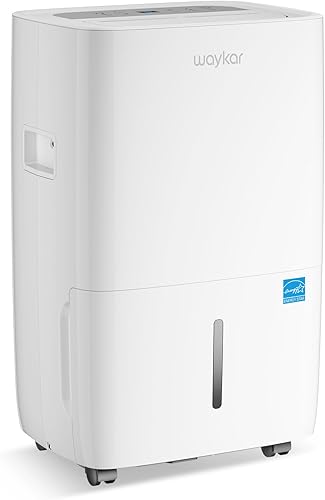
Waykar 80 Pints 5000 Sq. Ft: Best for wide humidity settings
- 80 pints per day at 95°F, 90% RH
- 30%–80% humidity control
- 90° auto swing
- ENERGY STAR certified
A broad humidity setting range and 90° auto swing suit a large room where you want adjustable targets and more even airflow.
Pros
- 30%–80% humidity control
- 90° auto swing
- Manual tank or continuous drainage
Cons
- 1.14-gallon tank
- Gravity drainage needs a suitable drain location
Waykar’s 80-pint unit pairs stated 5,000 sq ft coverage with a 30%–80% humidity setting range. Its daily capacity is measured at 95°F and 90% RH, so that figure isn’t a direct match to the hOmeLabs ratings.
The wide setting range gives more choice for a damp basement or a stuffy bedroom. You can aim lower for a very wet space or keep a milder target for everyday comfort.
The 90° auto swing spreads airflow across the room, and the included hose supports continuous gravity drainage. You can also use the 1.14-gallon tank, which has a full-tank alert.
Swinging airflow can help corners that a fixed outlet may miss. It does not replace open doors or good placement, but it can even out dry air across a large room.
The controls include two fan speeds, a timer and automatic defrost. Waykar describes the model as ENERGY STAR certified.
Choose it if a wide humidity setting range and moving airflow are useful in your basement or large room. Skip it if you can’t route a gravity hose and don’t want to empty a tank; compare the different design in our best Midea Cube dehumidifier options.
yaufey 80 Pint Dehumidifier for Basement: Best for flexible room settings
- 80 pints per day at 95°F, 90% RH
- Up to 5,500 sq ft stated coverage
- Four operating modes
- Three fan speeds
Four modes and three fan speeds let you choose settings for different rooms and humidity needs.
Pros
- Four operating modes
- Three fan speeds
- Tank and continuous drainage options
Cons
- 1.06-gallon tank
- Gravity drainage needs a suitable drain location
The yaufey 80-pint model offers four operating modes and three fan speeds, giving you several ways to adjust operation. Its stated capacity is 80 pints per day at 95°F and 90% RH, with coverage up to 5,500 sq ft.
More modes can help when one unit moves between rooms. A laundry space, a living area and a basement may each need a different target and fan level.
An included 3.28 ft hose supports gravity drainage, while the 1.06-gallon tank provides a manual option. The unit also has a 24-hour timer, humidity and temperature sensors, and auto restart.
The short hose length matters in planning. Measure from the outlet to the drain before you rely on continuous drainage for long runs.
The humidity range runs from 30% to 80% RH. These controls are useful when a room needs a specific target, though the room’s conditions should guide the setting.
Choose this model if you want more modes and fan speeds for a large basement or living area. Skip it if you prefer a pump or a simple control panel; if your basement runs cool, read about desiccant dehumidifiers with a pump.
Aiusevo 52 Pint Dehumidifier: Best for laundry room drying
- 52 pints per day at 95°F, 90% RH
- Up to 5,000 sq ft stated coverage
- Three operating modes
- 42 dB stated noise level
This 52-pint model offers DEHU, DRY and CONT modes, plus a tank or hose for water removal.
Pros
- Three operating modes
- Automatic defrost
- Child lock
Cons
- 0.66-gallon tank
- Drain hose needed for continuous use
Aiusevo’s 52-pint model is a middle option between the 50-pint units and the 74- or 80-pint picks. Its rating is 52 pints per day at 95°F and 90% RH, with stated coverage up to 5,000 sq ft.
That middle position suits shoppers who want a little more stated capacity without moving to the largest models. The rating conditions still need a close read before you compare it with hOmeLabs.
Three modes cover everyday humidity control, clothes drying and continuous operation. The 0.66-gallon tank is small, so the included hose may be more convenient for long run times when a suitable drain is available.
The small tank is the main trade off. It can work for short jobs, but frequent checks are likely if you run the unit for hours each day.
It also includes a digital humidity display, 24-hour timer, automatic defrost and child lock. Aiusevo states that noise can be as low as 42 dB.
The timer helps with drying jobs that you do not want to watch. The child lock helps keep settings steady in a family home.
Choose this model when you want multiple modes and a tank with a hose option. Skip it if you want to avoid frequent tank checks and don’t have a drain, since its tank is the smallest among these picks.
Waykar 80 Pints 2025 Energy Star Dehumidifier: Best for cooler basements
- 80 pints per day at 95°F, 90% RH
- Self-drying function
- Auto defrost
- Up to 5,000 sq ft stated coverage
The self-drying function activates after shutdown, while auto defrost is designed for operation in cool basements.
Pros
- Self-drying function
- Auto defrost
- 30%–80% humidity control
Cons
- 0.92-gallon tank
- 80-pint rating is measured in high-humidity conditions
This Waykar unit has a stated 80-pint daily capacity at 95°F and 90% RH and coverage up to 5,000 sq ft. At 86°F and 80% RH, Waykar gives a 62-pint daily figure.
That cooler figure gives a fairer sense of basement use. A warm damp room and a cool basement can give very different daily results.
Its self-drying function activates after shutdown, and auto defrost is designed for operation in cool basements down to 41°F. It also has auto swing airflow, adjustable humidity settings and a timer.
Self drying can help reduce remaining moisture inside the unit after a run. Auto defrost helps when frost would otherwise slow or stop a compressor in cold air.
The tank holds 0.92 gallons, and the included hose supports continuous drainage. Its modes are Auto and Continuous.
Auto mode suits a target humidity level, while Continuous mode suits a space that stays damp. The washable filter still needs regular cleaning, so check the manual for the schedule.
Choose it if you want self-drying and features intended for cooler basement conditions. Skip it if your main priority is a larger tank or a built-in pump.
AEOCKY 5000Sq.Ft Energy Star Version 6.0 Dehumidifier: Best for efficient large rooms
- 74 pints per day at 95°F, 95% RH
- Up to 5,000 sq ft stated coverage
- Drain hose included
- Auto-defrost system
This AEOCKY model has a lower stated daily capacity than the RHEA-001 and includes a drain hose for continuous drainage.
Pros
- Drain hose included
- Auto-defrost system
- Power-off memory function
Cons
- 1.45-gallon tank
- Capacity conditions differ from the 50-pint rating
AEOCKY’s LEO-Lite gives a stated 74 pints per day at 95°F and 95% RH and covers up to 5,000 sq ft. AEOCKY gives a 52-pint daily figure at 86°F and 80% RH.
The cooler figure is the one to weigh for a basement. It sits closer to the conditions many homes face during damp weather.
This model includes a drain hose and has a 1.45-gallon tank. Its features include adjustable humidity control, an auto-defrost system and a power-off memory function.
Power off memory can help after a brief outage. The unit can return to its prior settings, which matters in a smart socket setup or a space that loses power often.
AEOCKY describes it as an ENERGY STAR Version 6.0 model. Check the current certification and model details if certification is central to your choice.
The drain hose still needs a low drain point. If you plan tank use, the 1.45 gallon size will need regular emptying during wet periods.
Choose it if you want a hose-equipped AEOCKY model with stated coverage for a large home area. Skip it if your need is specifically for a 50-pint model or if the higher-capacity rating doesn’t match your room.
Wellsle 3500 Sq.Ft Dehumidifier: Best for quiet bedrooms
- 50 pints per day at 90°F, 80% RH
- Up to 3,500 sq ft stated coverage
- Continuous drain hose included
- 41 dB or lower claimed noise
Wellsle claims noise at or below 41 dB and includes a hose for continuous drainage in a bedroom or smaller large room.
Pros
- Drain hose included
- Child lock
- Washable air filter
Cons
- No tank volume stated
- Smaller stated coverage than other picks
Wellsle’s model offers a 50-pint daily rating at 90°F and 80% RH and stated coverage up to 3,500 sq ft. The brand claims noise at or below 41 dB and describes a dimming control panel for bedroom use.
The smaller stated coverage suits a bedroom or a more modest large room. It is less suited to a very large open basement where other picks state wider coverage.
A 6.6 ft drain hose is included for continuous drainage. The unit also has DEHU and DRY modes, a child lock, wheels and a washable filter.
DEHU mode holds a chosen humidity target, while DRY mode runs harder for laundry or a damp closet. The child lock helps keep those settings from being changed by accident.
No tank volume is stated, so plan to rely on the hose if you expect long run times. The stated coverage is smaller than most other picks here.
That missing tank detail should shape your setup plan. If you cannot route the hose, confirm how you will handle water before you buy.
Choose Wellsle for a 50-pint option aimed at a bedroom or more modest large room, especially when quiet operation and a drain hose matter. Skip it if you need the broadest stated coverage or want a published tank size.
What should you check before choosing a 50 pint dehumidifier?
Check the room conditions, drainage path and controls before settling on a capacity. These details affect how often you empty water and whether the unit can maintain a useful humidity level.
How should you compare 50 pint dehumidifier ratings?
A 50-pint rating measures daily moisture removal under stated conditions, and those conditions vary across models. The hOmeLabs units use 80°F and 60% RH, while Wellsle uses 90°F and 80% RH.
Several 80-pint models use 95°F and 90% or 95% RH. Compare similar conditions where possible, and treat stated coverage as a rough guide because room layout and moisture sources also matter.
How do you choose between a pump, hose and tank?
Choose a pump if water must move upward or travel along a route that won’t drain by gravity. A pump can lift water to a higher drain or carry it across a basement floor.
A gravity hose works when the drain sits below the outlet and the hose can slope down without kinks. Even a small rise can stop water from flowing as intended.
Use the tank when you can check and empty it regularly. Tank use suits a room you pass each day or a short drying job.
Before buying, check whether a hose is included, its length, the outlet position and whether your drain is close enough. Those practical details can matter more than a small difference in rated capacity.
Also check the tank size against the daily pint rating. A high daily figure can fill a small tank fast, which turns a simple unit into a frequent chore.
Think about winter and summer use too. A basement that stays damp all year may need continuous drainage, while a spare room may only need a tank for a few weeks.
If no drain is close, ask whether a pump model fits better. That one choice can decide how often you handle water and how steady the unit can run.
Where should you set up a portable dehumidifier?
Set it in the damp area with open space around the air intake and outlet, and keep it near a suitable drain if you plan to use a hose. Follow the unit’s manual for clearances, electrical setup and hose connection.
Keep interior doors open when you want air to circulate between connected rooms. A unit in a closed basement room won’t dry distant rooms effectively, and separate floors often need separate placement decisions.
What care helps a dehumidifier keep working?
Clean the washable filter on the schedule in the manual, and let it dry before reinstalling it. A clogged filter can restrict airflow and make moisture removal less effective.
Empty and rinse the tank when you use tank mode, and check the hose for kinks or buildup during continuous drainage. Before storing the unit for a season, follow the manual’s steps for draining and drying it.
What common buying and setup mistakes should you avoid?
Don’t treat a stated maximum coverage area as a guarantee for a divided home. Closed doors, ceiling height, dampness and airflow all affect how one portable unit serves a space.
Don’t compare daily pint figures without checking temperature and humidity conditions. Also avoid placing a gravity-drained unit where the hose must rise, assuming a hose is included without checking, or choosing a small tank for unattended operation without a drain plan.
Which 50 pint dehumidifier should you choose?
Choose the hOmeLabs pump model if you want Wi-Fi control and pump-assisted drainage. That fit suits a large residential space where the drain is not directly below the unit.
Pick the 52-pint Aiusevo or 50-pint Wellsle when their controls, stated conditions and room coverage suit your space. Aiusevo brings three modes, while Wellsle points toward quieter bedroom use.
Consider the 74- or 80-pint models when their higher-capacity conditions and drainage options fit your needs. Those ratings use warmer and wetter conditions, so compare them with care.
For a very damp basement, drain access may matter more than the pint number. A hose ready model can run longer without checks, while a pump model can reach a less convenient drain.
For a bedroom or laundry room, controls and noise may lead the choice. Modes, timers and a dimming panel can shape daily comfort more than a large coverage claim.
Before buying, compare capacity conditions, room layout and drain access. Write down the rating temperature and humidity for each shortlisted model.
Then check doors, ceiling height and moisture sources in the room. A leaky window, a wet wall or closed doors can change what one portable unit can do.
If the space is divided across floors, one unit may need help in more than one spot. For a divided home where one portable unit will not reach every area, see our guide to whole-house dehumidifiers.
Use a simple final rule. Match capacity conditions to your room, match drainage to your drain route, and match controls to the way you will actually use the unit.
Our top 3 picks at a glance
-
1
-
2
-
3
Best for very damp basements
AEOCKY 5500 Sq.Ft Energy Star Most Efficient
9.6/10 our score
See it on Amazon
Frequently asked questions
What does 50 pint mean on a dehumidifier?
A 50-pint rating refers to the amount of moisture a dehumidifier can remove in a day under stated test conditions. The hOmeLabs models give their 50-pint rating at 80°F and 60% RH, while Wellsle gives its rating at 90°F and 80% RH.
Compare capacity alongside the temperature and humidity conditions.
Is a 50-pint dehumidifier enough for a basement?
It can be, depending on the basement's size, dampness and conditions. The picks here state coverage from 3,500 to 7,500 sq ft, but those figures are not directly comparable across models.
Consider the room's moisture level, drainage options and the conditions used for each capacity rating.
Should I choose a 50-pint or 80-pint dehumidifier?
Choose based on the room and rating conditions, not the pint number alone. Several 80-pint models here state capacity at 95°F and 90% or 95% RH, while hOmeLabs rates its 50-pint models at 80°F and 60% RH.
Compare drainage and controls too, then consider the actual space.
Is a pump better than a drain hose?
A pump can move collected water upward or over a longer route, while a gravity hose needs a drain below the outlet. The hOmeLabs pump model is the only pick here with a built-in pump.
For more help weighing the options, read our guide to dehumidifiers with a pump versus no pump.
Can one portable dehumidifier handle a whole house?
A portable unit may help in an open area, but walls, closed doors and separate floors can limit how far dry air travels. For a large or divided home, compare portable placement with a whole-house system.
Our guide to whole-house versus portable dehumidifiers explains the main trade-offs.