9 Best Freezer Thermometers with Probes (November 2026)
The best freezer thermometers with probes include the MOCREO WiFi Thermometer Freezer Alarm for phone alerts and records, the MOCREO Freezer & Fridge Thermometer for MOCREO system owners, and the Geevon Refrigerator Thermometer 2 Pack IP65 Waterproof for two-appliance kitchens.
On this page (5 sections)
The best freezer thermometer with probe for remote alerts is the MOCREO WiFi Thermometer Freezer Alarm, with two wireless sensors, app and email notifications, and temperature history export. For simpler local monitoring, Geevon provides two external displays, while TempPro pairs a sensor with a receiver for at-a-glance readings.
A probe thermometer helps you check conditions inside a freezer without putting the display in the cold compartment. The best setup depends on whether you need app alerts when away, a nearby receiver, or a basic external readout.
For a broader appliance comparison, see our guide to the best fridge and freezer thermometers. If remote updates are your priority, compare options in our wireless freezer thermometer guide.
Our picks at a glance
-
1
 Best for phone alerts and records
MOCREO WiFi Thermometer Freezer Alarm
9.5/10 our score
See it on Amazon -
2

-
3
 Best for two-appliance kitchens
Geevon Refrigerator Thermometer 2 Pack IP65 Waterproof
9.3/10 our score
See it on Amazon
- 4
 Check it
Rubbermaid Commercial Products Fridge/Freezer Monitoring Thermometer
Best for battery-free kitchens - 5
 Check it
TempPro TempAir Wireless Freezer Fridge Thermometer
Best for no-Wi-Fi households - 6
 Check it
LSNDRG Freezer Thermometer with Alarm
Best for two storage locations - 7
 Check it
Traceable Fridge/Freezer Digital Thermometer with Calibration;
Best for bottle-based monitoring - 8
 Check it
Traceable® Digital Thermometers with Calibration
Best for visible temperature extremes - 9
 Check it
VLEJEARI Refrigerator Thermometer Freezer Alarm Digital Freezer
Best for wired outside readings
Which freezer thermometers with probes fit different needs?
The MOCREO WiFi Thermometer Freezer Alarm is the top choice for remote alerts, while other picks serve local monitoring, multi-appliance setups, and calibration needs. The products appear in descending score order, with the strongest fit for this keyword first.
MOCREO WiFi Thermometer Freezer Alarm: Best for phone alerts and records
- 2 wireless probe sensors
- App, email and hub alerts
- CSV data export
Two sensors and remote alerts suit households monitoring more than one cold-storage area. The app also offers temperature graphs and CSV export.
Pros
- Two sensors included
- App and email alerts
- Temperature history export
Cons
- Requires 2.4 GHz Wi-Fi for remote features
- Hub has no LCD display
The MOCREO WiFi Thermometer Freezer Alarm suits a home with more than one cold-storage area or a freezer that needs monitoring while you’re away. It includes two wireless sensors, and each probe cable has a clip and organizer.
The system sends app push notifications, email alerts, or a 90 dB hub alarm. You can mute the hub beep in the app, view graphs, and export temperature records as CSV files.
The sensor reads from -40°F to 158°F, with stated accuracy of ±0.9°F. Its 0.9 mm flat cable is designed to pass through a refrigerator door seal.
The H6Lite hub uses 2.4 GHz Wi-Fi and connects with up to 30 compatible MOCREO BLE sensors within a stated 230 ft range. Choose it when remote alerts and records matter; skip it if you want a display on the hub, since readings are managed through the app.
Set the hub where it can maintain a Wi-Fi connection, then place one sensor in each appliance or storage area you want to watch. The kit makes the most sense if you’ll use both sensors; for one additional freezer on a system you already own, the add-on below may be a better fit.
MOCREO Freezer & Fridge Thermometer: Best for MOCREO system owners
- 0.9 mm flat probe cable
- App and email alerts through a compatible hub
- Up to 2 years of app history
This sensor adds another freezer to a compatible MOCREO hub. Its flat cable is designed to pass through a door gasket while the sensor body stays outside.
Pros
- Flat cable passes through a door gasket
- Works with several MOCREO hubs
- Phone and email alerts through a hub
Cons
- Requires a compatible hub
- No standalone Wi-Fi connection
This MOCREO sensor is the right match if you already have a compatible hub and want to add one more fridge or freezer. It joins the same app system instead of requiring a separate full kit.
The 4.9 ft flat probe cable lets the sensor body stay outside while the probe sits near stored food. The cable is designed to pass through a door gasket, so there’s no need to drill a hole or hold the door open.
A compatible hub sends high and low alerts through the app and email. Some hub models also provide a local alarm, and the sensor reads from -40°F to 158°F with stated accuracy of ±0.9°F.
This is not a standalone Wi-Fi thermometer. Choose it if you own an H1, H2, H3, H5, or H6 hub and need another sensor; skip it if you need a complete first-time setup.
Place the probe away from fans and walls when you want a representative air reading. Once the cable is in place, check that the door closes all the way around it.
Geevon Refrigerator Thermometer 2 Pack IP65 Waterproof: Best for two-appliance kitchens
- 2 thermometers with external sensors
- Magnetic back, stand and hook
- IP65 waterproof design
The two-pack offers an external display and sensor arrangement for checking separate appliances. Each thermometer has a magnetic back, stand and hook.
Pros
- Two thermometers in the pack
- Multiple placement options
- Max/min reset function
Cons
- Accuracy is ±2°F
- No remote app alerts
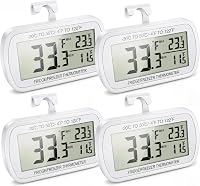
Geevon’s two-pack suits a household checking two appliances with a separate external LCD for each. Each thermometer has a magnetic back, stand, and hook, so you can put the display where it’s easy to read.
The units measure from -22°F to 122°F with stated accuracy of ±2°F. The screen switches between Celsius and Fahrenheit, and the three buttons handle power, unit selection, and max/min reset.
Geevon rates the design IP65 for water resistance, a useful feature around damp areas. This is a local-reading setup with no app or email alerts, so choose it for simple checks at home and skip it if you need updates while away.
Use the external sensor arrangement as intended, with the sensor inside and the display outside. Keep the screen in a spot where it won’t be knocked off when you open the appliance or move items nearby.
For a magnetic option focused on one appliance, see our guide to magnetic freezer thermometers.
Rubbermaid Commercial Products Fridge/Freezer Monitoring Thermometer: Best for battery-free kitchens
- Mechanical dial
- Stainless steel construction
- No batteries required
This mechanical thermometer gives an at-a-glance reading inside a fridge or freezer without batteries. It has a dial rather than an external probe display.
Pros
- No batteries needed
- Hangs or stands
- Reads Fahrenheit and Celsius
Cons
- No external display
- No alerts or recorded history
Rubbermaid’s mechanical dial fits anyone who wants a simple in-appliance reading without batteries. Its stainless steel body and shatter-proof lens are made for use in a kitchen or commercial food space.
The dial shows Fahrenheit and Celsius and can hang or stand. Rubbermaid describes it for refrigerators, mini fridges, freezers, coolers, and other cooling-based food appliances.
This model has no probe, external display, alarm, or temperature memory. Choose it for an at-a-glance check inside the appliance; skip it if you need a probe or a warning when the temperature changes.
Place it where the dial remains visible and isn’t buried behind food. If a digital readout is more useful, compare our digital freezer thermometer picks.
TempPro TempAir Wireless Freezer Fridge Thermometer: Best for no-Wi-Fi households
- Pre-paired wireless sensor and receiver
- Adjustable high and low alarms
- Backlit display with max/min records
A pre-paired sensor and receiver provide local readings and audio-visual alarms without Wi-Fi setup. The receiver shows fridge and freezer temperatures.
Pros
- No Wi-Fi or registration needed
- Backlit receiver display
- Rechargeable transmitter battery
Cons
- Wireless range varies with placement
- No phone notifications
TempPro works well for people who want a wireless sensor and nearby receiver without Wi-Fi setup. The transmitter and receiver arrive pre-paired, so you can power them on and begin monitoring.
The backlit receiver shows fridge and freezer readings, all-time max/min records, and low-battery status. You can set high and low limits, with audio-visual alarms at the receiver when readings cross them.
TempPro states accuracy of ±0.9°F across a range of -40°F to 158°F. Its stated RF range is up to 80 ft, though walls and placement can reduce the distance.
The transmitter has a rechargeable lithium battery, and the receiver uses two AAA batteries. Choose this for local monitoring from a receiver; skip it if you need phone alerts when you’re away.
Put the receiver somewhere you’ll notice its screen and alarm, then check that it remains connected from the freezer’s usual position. If the signal is unreliable, move the receiver closer before changing the sensor’s placement.
LSNDRG Freezer Thermometer with Alarm: Best for two storage locations
- 2 probes for separate locations
- Audible and visual alarms
- Backlit display with 24-hour max/min
Two sensors let the display monitor two locations, such as a fridge and freezer. The system uses local alarms and does not need Wi-Fi or an app.
Pros
- Monitors two locations
- No internet setup
- Display offers wall, magnetic and stand placement
Cons
- No phone alerts
- Wireless range depends on conditions
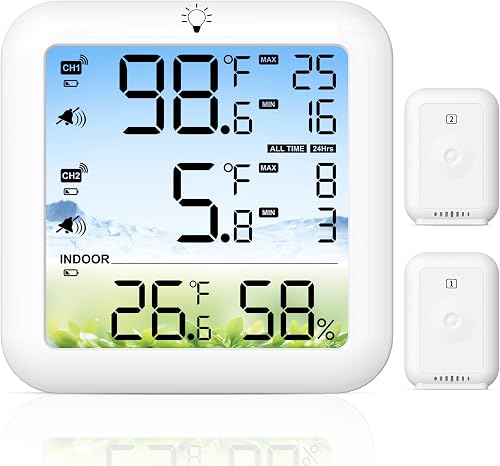
The LSNDRG thermometer is a fit for monitoring two locations, such as a fridge and a deep freezer, from one display. Its two sensors feed a backlit receiver that records max and min temperatures over 24 hours.
You can set temperature limits and get visual and audible alerts without Wi-Fi or an app. The stated wireless range is up to 330 ft, but real range depends on the setting and sensor placement.
The probe range is -40°F to 140°F, while the display’s indoor sensor reads from -14.2°F to 140°F. The receiver can sit on a stand, attach magnetically, or mount on a wall.
Choose it for two-location checks and local alarms; skip it if you need alerts on your phone. Before relying on the readings, label or otherwise keep track of which sensor is paired with each appliance.
Traceable Fridge/Freezer Digital Thermometer with Calibration;: Best for bottle-based monitoring
- Bottle probe
- Digital indicator
- Calibration certificate
A bottle probe suits monitoring where the probe's contained medium is useful to your process. Traceable products include a calibration certificate.
Pros
- Wide stated temperature range
- Bottle probe design
- Calibration certificate included
Cons
- No app or remote alerts
- Bottle probe differs from a bare air sensor
Traceable’s bottle-probe model is aimed at a process where you want to monitor a probe inside a bottle or contained medium, rather than exposed freezer air. Its stated temperature range is -58°F to 158°F, and it includes a calibration certificate.
A bottle probe changes what the temperature reading represents. The surrounding medium can respond to temperature changes differently from the freezer air, so choose this design only when that matches your monitoring procedure.
This is a digital indicator without app alerts or a remote receiver. Choose it for bottle-based monitoring and calibration documentation; skip it if your main need is an easy external display for a household freezer.
Keep the probe and its cable arranged according to the device instructions, and make sure the display remains readable. For current and min/max values on a single screen, the other Traceable option below offers a different layout.
Traceable® Digital Thermometers with Calibration: Best for visible temperature extremes
- Bullet probe
- Triple display for current, minimum and maximum
- High and low alarms
The triple display shows current, minimum and maximum temperatures together. High and low alarms can be set in 1° increments.
Pros
- Shows current and stored extremes together
- High and low alarms
- NIST-traceable certificate
Cons
- No wireless remote display
- Memory remains until cleared
This Traceable thermometer is suited to readers who want current, minimum, and maximum temperatures visible together. Its bullet probe can read either ambient or probe temperature.
The stored minimum and maximum remain until you clear the memory. High and low alarms can be set in 1° increments, and the included certificate is NIST-traceable.
It works as a local digital thermometer rather than an app-connected monitor. Choose it when recorded extremes, adjustable alarms, and calibration documentation matter; skip it if you need a receiver across the room or remote alerts.
Clear the memory when you begin a new monitoring period so the recorded extremes have a clear start point. Check the alarm limits and display units before relying on them for routine checks.
VLEJEARI Refrigerator Thermometer Freezer Alarm Digital Freezer: Best for wired outside readings
- External sensor with 1.5 m cable
- High and low temperature alarm
- Magnetic main unit
The wired sensor sits inside while the magnetic display stays outside the appliance. Its alarm sounds for 60 seconds when the set limit is crossed.
Pros
- External display and wired sensor
- Magnetic placement
- Includes an AAA battery
Cons
- Cable crosses the door area
- No remote phone alerts
VLEJEARI keeps the main display outside the appliance while a wired external sensor sits inside. Its 1.5 m cable connects the two, and the magnetic main unit can attach to the freezer exterior.
You can switch between Celsius and Fahrenheit and set high and low temperature limits. When the sensor crosses a set limit, the alarm sounds for 60 seconds; pressing a key stops the sound.
The main unit can also sit on a folding stand or hang from a wall hook. Choose it for a basic wired sensor and outside display; skip it if the cable can’t pass through your freezer door without affecting the seal.
Route the cable with no sharp bends or pinches, then close the door and inspect the gasket area. If the door resists or leaves a gap, reposition the cable before using the thermometer.
How do you choose the best freezer thermometer with probe?
Choose the display and alert method first, then match the probe style and cable to your appliance. Those choices determine whether you can read the temperature conveniently and whether you’ll learn about a change in time to respond.
Do you need a freezer thermometer probe for air or a bottle?
A freezer thermometer probe can measure air directly or sit in a bottle, depending on its design. Traceable’s bottle-probe model fits a process that calls for a contained medium, while its bullet-probe model can read ambient or probe temperature.
For a household freezer, a probe placed away from fans and walls can provide a more representative air reading. If you need a buffered or documented measurement, choose a probe style that matches your procedure rather than assuming all probes measure the same thing.
Do you want an app, a receiver, or an external display?
An app is useful when you need remote alerts, while a receiver suits monitoring from another room. An external LCD is a practical middle ground if you want to read the temperature without opening the freezer but don’t need phone notifications.
MOCREO’s complete kit provides app and email alerts through its hub. TempPro and LSNDRG use local receivers, while Geevon gives each appliance an external display; choose based on where you’ll be when an alert matters.
Will the cable fit through the freezer door?
A cable needs to pass through the door without keeping the gasket from sealing. MOCREO specifies a 0.9 mm flat cable for this purpose, while VLEJEARI uses a wired sensor cable and Geevon uses an external sensor arrangement.
After routing a cable, close the door and inspect the gasket where it crosses. Don’t force the door shut against a cable that prevents full closure, and avoid pinching the cable in a way that could damage it.
How many sensors do you actually need?
One sensor is enough when you have one freezer and only need one reading. Two sensors make more sense when you want to monitor separate appliances or locations from the same setup.
The MOCREO kit includes two sensors; its MS2 add-on is for an existing compatible hub. Geevon’s pack includes two thermometers, and LSNDRG uses two sensors with one display, so compare how each system presents readings before choosing.
When does calibration documentation matter?
Calibration documentation matters when you need a defined record or a process that depends on documented accuracy. Both Traceable options include calibration documentation, while the other picks emphasize alerts, wireless readings, or easy local checks.
For everyday household monitoring, ease of reading and suitable alarms may matter more. For workplace records, check the calibration procedure and interval required for your use rather than assuming a certificate alone covers every need.
How should you set up and care for a freezer probe?
Set up a freezer probe by placing the sensor where it can measure the intended area, routing its cable safely, and checking the display or alerts before depending on it. A few placement and maintenance habits help keep readings useful over time.
First, decide whether you want an air reading or a bottle reading. Keep an air probe away from fans, walls, and packages that could press against it; for a bottle probe, follow the device instructions and keep the surrounding medium consistent with your monitoring purpose.
Next, choose a cable route that lets the door close fully. After closing the door, check the gasket for a visible gap and make sure the cable isn’t crushed or sharply bent.
For a wireless system, place the receiver or hub where it can communicate with the sensor and, for app systems, maintain its network connection. Confirm that readings appear on the display or app, and check that any alarms are enabled with limits appropriate to your use.
Keep the display where you can see or hear it. Replace or recharge batteries when the device indicates low power, and periodically confirm that the sensor still reports a reading; a disconnected sensor can leave you with an old value that looks current.
Clean only the parts and surfaces as directed for the model. Geevon specifies wipe-clean care, while MOCREO’s sensor care instructions say not to soak it; keep electronic display units and connectors away from water unless the device instructions permit exposure.
What mistakes can make freezer readings less useful?
The most common mistakes are choosing the wrong probe style, routing a cable through a poor seal, and assuming every wireless system sends alerts to a phone. Check these details before you rely on a reading.
- Putting an air probe beside a fan or wall: That placement may not reflect conditions in the area you want to monitor. Move the probe away from airflow and surfaces when you need a representative air reading.
- Treating a bottle probe like an air sensor: The bottle’s contents can respond more slowly than freezer air. Use that setup only when a contained reading suits your monitoring needs.
- Leaving the cable across the gasket without checking the door: A cable that holds the door open can let cold air escape. Close the door and inspect the seal after installation.
- Assuming “wireless” means app alerts: A radio sensor may communicate only with a nearby receiver. Choose Wi-Fi and a compatible hub if you need notifications away from home.
- Ignoring power and connection warnings: A low battery or offline hub can interrupt monitoring. Respond to battery warnings and check the connection after moving equipment or changing your network.
- Forgetting to clear stored extremes: Some models retain max/min readings until they’re reset. Clear the memory when beginning a new tracking period so old readings don’t confuse the current one.
- Setting alarms without checking units: Confirm whether the display shows Fahrenheit or Celsius and verify the high and low limits before relying on an alarm.
Which freezer thermometer with probe should you choose?
Choose MOCREO’s Wi-Fi kit for two sensors, remote notifications, and exportable history. Pick its MS2 add-on if you already have a compatible hub, Geevon for two external displays, or TempPro for a pre-paired local receiver without Wi-Fi.
Choose LSNDRG when one receiver needs to cover two locations, and choose a Traceable model when a bottle probe, calibration documentation, or visible min/max readings fit your process. If you only need a basic in-appliance check, Rubbermaid’s mechanical dial is the simplest pick, though it has no probe or alarm.
Before buying, match the sensor type to what you need to measure and confirm that a cable can pass through the door without interfering with the seal. If you want to compare more alert options, continue to our guide to freezer thermometers with alarms.
Our top 3 picks at a glance
-
1
Best for phone alerts and records
MOCREO WiFi Thermometer Freezer Alarm
9.5/10 our score
See it on Amazon -
2
-
3
Best for two-appliance kitchens
Geevon Refrigerator Thermometer 2 Pack IP65 Waterproof
9.3/10 our score
See it on Amazon
Frequently asked questions
Why choose a freezer thermometer with a probe?
A probe measures inside the freezer while the display or wireless receiver can stay outside, making it easier to check conditions without opening the door. Some models send readings to a nearby receiver; Wi-Fi systems can send alerts to an app or email.
Choose by how you want to read the temperature and how quickly you need to know about a change.
Can a probe cable stop a freezer door from sealing?
A cable can affect the seal if it is too thick or routed poorly. MOCREO’s MS2 cable is 0.9 mm flat and designed to pass through a door gasket, while the VLEJEARI thermometer has a wired sensor cable.
Route the cable without bending or pinching it, then check that the door closes fully.
Is a wireless freezer thermometer the same as a Wi-Fi thermometer?
No. A wireless thermometer can send readings to a nearby receiver over radio, while Wi-Fi can connect a system to app or email alerts over the internet.
TempPro and LSNDRG use local receivers.
MOCREO’s Wi-Fi kit supports remote notifications through its hub, so choose it if you need updates away from home.
Where should I place a freezer probe?
Place the probe where you want to monitor conditions, away from fans and walls if you need a representative air reading. Keep the sensor and cable clear of food packages and moving parts.
A bottle probe measures the temperature of its surrounding medium rather than exposed freezer air, so use it when that matches your monitoring needs.
Do freezer thermometers with probes need calibration?
Calibration matters most when readings support formal records or a process with defined accuracy needs. The Traceable models in this guide include calibration documentation, while other picks focus on household displays, alarms, or remote monitoring.
Follow the device instructions for calibration checks and any interval required by your workplace.