9 Best Indoor Outdoor Thermometers with Multiple Sensors (November 2026)
The best indoor outdoor thermometers with multiple sensors include the TempPro TempAir 500 FT Indoor Outdoor Thermometer for gradual expansion, the Indoor Outdoor Thermometer Wireless Digital Hygrometer with for adjustable backlighting, and the Geevon Indoor Outdoor Thermometer Wireless with 3 for audible alerts.
On this page (4 sections)
The best indoor outdoor thermometer with multiple sensors for most homes is the TempPro TempAir 500 FT, which supports up to 3 sensors and has a stated 500 ft range. Choose U UNNI for 3 sensors included and adjustable backlighting, or Geevon if you want audible alerts.
A multi-sensor thermometer lets you compare conditions in separate places from one receiver. It can help you check a nursery, basement, greenhouse or garage without carrying a separate thermometer from room to room.
Start by counting the remote locations you want to monitor, then compare which models show all those readings at once. For a broader overview of single and multi-sensor options, see our best indoor outdoor thermometer guide.
Our picks at a glance
-
1
 Best for gradual expansion
TempPro TempAir 500 FT Indoor Outdoor Thermometer
9.7/10 our score
See it on Amazon -
2
 Best for adjustable backlighting
Indoor Outdoor Thermometer Wireless Digital Hygrometer with
9.7/10 our score
See it on Amazon -
3
 Best for audible alerts
Geevon Indoor Outdoor Thermometer Wireless with 3
9.5/10 our score
See it on Amazon
- 4
 Check it
Baldr Wireless Indoor Outdoor Thermometer with 3
Best for separate zone alerts - 5
 Check it
ORIA Indoor Outdoor Thermometer
Best for sheltered outdoor placement - 6
 Check it
Newentor Weather Station with 3-Sensor
Best for forecast and pressure - 7
 Check it
AMIR Indoor Outdoor Thermometer
Best for 60-second updates - 8
 Check it
TempPro TempAir 500FT Indoor Outdoor Thermometer Wireless
Best for ready-set alerts - 9
 Check it
Geevon Indoor Outdoor Thermometer Wireless 3 Remote
Best for large display digits
Which indoor outdoor thermometers with multiple sensors stand out?
The TempPro TempAir 500 FT suits buyers who may add sensors over time and want a longer stated range. U UNNI and Geevon include 3 remote sensors, while other picks add channel alerts, larger screens or weather readings.
We compared sensor capacity, stated range, display features and the readings each system offers. The scores reflect how well those features fit the needs of someone monitoring several locations.
| Product | Best for | Sensor capacity | Stated range | Readings | Our score |
|---|---|---|---|---|---|
| TempPro TempAir 500 FT Indoor Outdoor Thermometer | gradual expansion | Up to 3 sensors | 500 ft | Temperature and humidity | 9.7 |
| Indoor Outdoor Thermometer Wireless Digital Hygrometer with | adjustable backlighting | Up to 330 ft | 9.7 | ||
| Geevon Indoor Outdoor Thermometer Wireless with 3 | audible alerts | 200 ft | 9.5 | ||
| Baldr Wireless Indoor Outdoor Thermometer with 3 | separate zone alerts | 9.2 | |||
| ORIA Indoor Outdoor Thermometer | sheltered outdoor placement | 328 ft | Temperature and humidity | 9.0 | |
| Newentor Weather Station with 3-Sensor | forecast and pressure | 8.8 | |||
| AMIR Indoor Outdoor Thermometer | 60-second updates | 328 ft | 8.5 | ||
| TempPro TempAir 500FT Indoor Outdoor Thermometer Wireless | ready-set alerts | 500 ft | 8.3 | ||
| Geevon Indoor Outdoor Thermometer Wireless 3 Remote | large display digits | 200 ft | 8.1 |
TempPro TempAir 500 FT Indoor Outdoor Thermometer: Best for gradual expansion
TempPro TempAir 500 FT Indoor Outdoor Thermometer: Best for gradual expansion
- Supports up to 3 sensors
- Stated wireless range of 500 ft
- Temperature and humidity readings
- Daily and all-time max and min records
The receiver can display readings from up to 3 sensors, so you can start with one and add sensors for more locations. Max and min records and trend arrows help you follow changes.
Pros
- Supports up to 3 sensors
- 500 ft stated range
- Tracks humidity as well as temperature
Cons
- Includes 1 sensor
- Sensor resynchronization may be needed after a battery change
The TempPro TempAir 500 FT is a flexible starting point if you want to monitor more than one remote location over time. It includes 1 sensor and supports up to 3, so you can add sensors as your setup grows.
Its stated wireless range is 500 ft, and the system reports temperature and humidity. The receiver tracks all-time and 24-hour max and min readings, with trend arrows to show whether a remote reading is rising or falling.
The remote sensor measures from -58°F to 158°F, with stated temperature accuracy of ±2°F. Its humidity range is 10% to 99%, with stated accuracy of ±2% to 3% RH.
If you replace a remote sensor’s battery, TempPro instructs you to hold the receiver’s CH/SYNC button for 3 seconds to register it again. The receiver can also resynchronize automatically after its batteries are reinstalled within 3 minutes.
Choose it if you want to add sensors gradually and value the long stated range. Skip it if you need several sensors in the box right away, since this version includes only one.
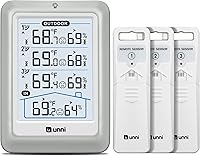
Indoor Outdoor Thermometer Wireless Digital Hygrometer with: Best for adjustable backlighting
Indoor Outdoor Thermometer Wireless Digital Hygrometer with: Best for adjustable backlighting
- 3 outdoor sensors included
- 4.5 in display
- USB or battery power
- Daily max and min records
U UNNI includes 3 sensors and a 4.5 in display with adjustable backlight settings. USB power can keep the backlight on, while daily records reset automatically every 24 hours.
Pros
- Includes 3 sensors
- Adjustable backlight
- Temperature and humidity alerts
Cons
- Humidity accuracy is stated as ±5%
- Batteries are not included
U UNNI includes 3 outdoor sensors, so you can begin tracking several spots without buying sensors separately. The display can show readings from 3 sensors and has a 4.5 in screen.
Power it by USB to keep the backlight on, then choose high, low or off brightness. It can also run on batteries, and the display is designed for tabletop or wall-mounted placement.
The thermometer supports temperature and humidity readings, trend indicators, a comfort indicator, and outdoor temperature and humidity alerts. Daily max and min records reset automatically every 24 hours.
The stated transmission range is up to 330 ft. Temperature accuracy is ±2°F and humidity accuracy is ±5%; the stated indoor temperature range starts at 14.2°F, so check that limit if you plan to use the display in a cold space.
Choose U UNNI if you want 3 sensors in the box and a backlight you can adjust. Skip it if you need included batteries or depend on readings in a space colder than its stated indoor range.
Geevon Indoor Outdoor Thermometer Wireless with 3: Best for audible alerts
Geevon Indoor Outdoor Thermometer Wireless with 3: Best for audible alerts
- 3 remote sensors included
- Monitors 4 locations
- Manual high and low alerts
- Temperature and humidity readings
Geevon's 3 remote sensors let the display monitor 4 locations, including the indoor unit. You can set high and low temperature and humidity thresholds for audible alerts.
Pros
- 3 sensors included
- Alerts for temperature and humidity
- Max and min records
Cons
- Remote sensors need AAA batteries
- Stated range is 200 ft
Geevon includes 3 remote sensors and supports readings from 4 locations at once, counting the indoor unit. Its stated range is 200 ft, which may suit a typical home layout if walls and other obstacles do not interrupt the signal.
You can set high and low temperature and humidity limits manually. The receiver sounds an alarm when a reading reaches a limit, while max and min records and trend arrows give you more context about changing conditions.
The remote temperature range is -58°F to 158°F, with stated accuracy of ±1.8°F. Humidity range is 20% to 95%, with stated accuracy of ±5%.
The base station uses 2 AA batteries, and each remote sensor uses 2 AAA batteries, which are not included. Geevon describes the remote sensor as water-resistant, but not completely waterproof, so put it in a sheltered place.
Choose this Geevon if you want audible alerts for readings that cross a limit. Skip it if the sensors must sit in exposed rain or you need a longer stated range.
Baldr Wireless Indoor Outdoor Thermometer with 3: Best for separate zone alerts
Baldr Wireless Indoor Outdoor Thermometer with 3: Best for separate zone alerts
- 3 remote sensors and 4-zone display
- 4.8 in LCD
- Per-channel alerts
- Solar panel extends battery life
Baldr shows readings from 3 sensors plus the main unit across 4 zones. Per-channel alerts and a screen flash can help draw attention to a reading outside your chosen range.
Pros
- Displays 4 zones at once
- Alerts for each channel
- Automatic backlight in low light
Cons
- Battery details differ between the feature description and included-components field
- No WiFi connection
Baldr displays readings from 3 remote sensors plus the main unit across 4 zones on a 4.8 in LCD. Its per-channel alerts and screen flash can draw attention to a zone outside the temperature or humidity range you set.
The system updates readings every 30 seconds, according to the feature description. A light sensor turns on the orange backlight in low light, and daily max and min records reset every 24 hours.
Baldr states an outdoor temperature range of -40°F to 158°F, indoor range of 14.2°F to 122°F and humidity range of 20% to 95%. It also states temperature accuracy of ±0.9°F and humidity accuracy of ±5%.
Battery inclusion is unclear: the feature description says 9 AA batteries are included, while the included-components information says they are not. The unit does not need WiFi.
Choose Baldr if you want separate alerts for different monitored locations. Skip it if battery certainty is essential before you buy, and confirm the battery requirements first.
ORIA Indoor Outdoor Thermometer: Best for sheltered outdoor placement
ORIA Indoor Outdoor Thermometer: Best for sheltered outdoor placement
- 3 wireless sensors included
- Stated signal distance of 328 ft
- Max and min records
- Backlight turns off after 10 seconds
ORIA includes 3 sensors and records max and min temperature and humidity readings. Its backlight turns off after 10 seconds without an operation.
Pros
- 3 sensors included
- Max and min records
- Wall-mount or tabletop placement
Cons
- Sensors are not waterproof
- Batteries are not included
ORIA comes with 3 wireless sensors and records max and min temperature and humidity for the indoor and outdoor readings. Its stated signal distance is 328 ft, and readings update every 60 seconds.
The display has a backlight you can turn on with the Light button. It switches off after 10 seconds without another operation, which helps keep the screen readable at night without leaving the light on.
ORIA gives an outdoor temperature range of -40°C to 60°C, an indoor range of 0°C to 60°C and a humidity range of 10% to 99%. Its stated accuracy is ±1°C for temperature and ±5% for humidity.
The station needs 3 AAA batteries and each sensor needs 2 AAA batteries. These batteries are not included, and ORIA says the transmitters are not waterproof.
Choose ORIA if you want basic multi-location readings and can keep sensors under cover. Skip it if you need outdoor transmitters exposed to rain or prefer a display that stays lit.
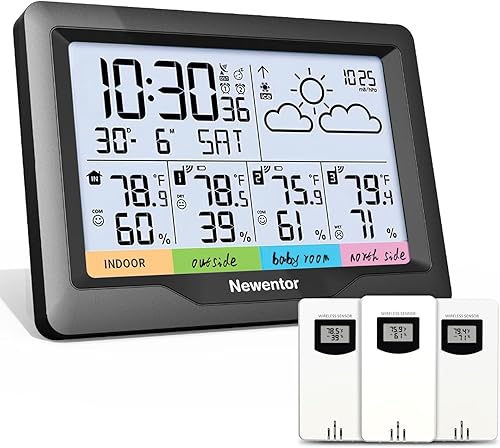
Newentor Weather Station with 3-Sensor: Best for forecast and pressure
Newentor Weather Station with 3-Sensor: Best for forecast and pressure
- 3 remote sensors and 4-zone monitoring
- Atomic clock and alarm
- Barometric pressure and weather forecast
- AA battery operation
Newentor pairs 3 remote sensors with a station that also shows barometric pressure, a forecast, date and time. It suits buyers who want more than temperature and humidity readings.
Pros
- Monitors 4 locations at once
- Includes clock and calendar features
- Shows barometric pressure and forecast
Cons
- Forecast needs 7–10 days for local calibration
- Battery life and accuracy are maker-stated claims
Newentor displays temperature and humidity for 4 locations at once, using its 3 remote sensors and indoor station. It also adds barometric pressure, air pressure trends, a weather forecast, an atomic clock, an alarm and a calendar.
The stated wireless range is 200 ft. Newentor describes the station as battery powered and includes 3 outdoor sensors.
The station records min and max data for its 3 wireless channels. Its forecast feature needs 7–10 days for barometric calibration in your location, so give it time before relying on the local forecast.
Newentor states ±1°F accuracy and battery life of up to 12–24 months. Actual battery life can vary with setup and conditions.
Choose Newentor if you want temperature and humidity alongside pressure and a forecast. It also provides clock information.
Skip it if you want a straightforward thermometer without those extra readings.
For a thermometer-focused comparison, see our best wireless thermometer with multiple sensors guide.
AMIR Indoor Outdoor Thermometer: Best for 60-second updates
AMIR Indoor Outdoor Thermometer: Best for 60-second updates
- 3 transmitters included
- Stated signal distance of 328 ft
- Max and min readings
- Clock, alarm and calendar
AMIR includes 3 transmitters for tracking temperature and humidity in several spots. The display also has max and min records, a clock, an alarm and a calendar.
Pros
- 3 transmitters included
- Max and min records
- Backlight for night viewing
Cons
- Batteries are not included
- Readings update every 60 seconds
AMIR includes 3 transmitters for monitoring temperature and humidity in different locations. It records max and min values, has a stated signal distance of 328 ft and updates readings every 60 seconds.
The display adds a clock, alarm, calendar, snooze and light. Its humidity comfort icon marks readings as dry, comfortable or wet, with the stated comfort band from 45% to 65% humidity.
The stated temperature range is 0°C to 60°C indoors and -40°C to 60°C outdoors. Temperature accuracy is ±1°C, while humidity accuracy is ±5%.
The station needs 3 AAA batteries and each sensor needs 2 AAA batteries. AMIR says these are not included.
Choose AMIR if you want three transmitters plus a clock and calendar on the display. Skip it if you need updates more often than every 60 seconds or batteries included.
TempPro TempAir 500FT Indoor Outdoor Thermometer Wireless: Best for ready-set alerts
TempPro TempAir 500FT Indoor Outdoor Thermometer Wireless: Best for ready-set alerts
- 3 sensors included
- Monitors 4 locations
- Stated range of 500 ft
- Temperature and humidity alerts
This TempPro version includes 3 sensors and alerts when readings move outside the temperature or humidity ranges you set. The stated 500 ft range can suit locations farther from the display.
Pros
- 3 sensors included
- Alerts for temperature and humidity
- Batteries included
Cons
- Only 3 remote channels are described
- Range depends on conditions between sensor and receiver
This TempPro model includes 3 sensors and monitors 4 locations at once, including the indoor unit. It has a stated wireless range of 500 ft and comes with 9 AAA batteries.
You can set temperature and humidity limits and receive alerts when readings move outside those ranges. The described uses include greenhouses, basements, garages, RV bays, reptile areas and wine cellars.
TempPro states temperature accuracy of ±0.5°F and humidity accuracy of ±2% to 3% RH. It also describes all-time and 24-hour max and min readings.
The sensor is described as waterproof. Wireless range can vary with walls and other obstacles.
Choose this model if you want 3 sensors, batteries and preset temperature and humidity alerts together. Skip it if you need more than 3 remote channels, since only 3 are described.
Geevon Indoor Outdoor Thermometer Wireless 3 Remote: Best for large display digits
Geevon Indoor Outdoor Thermometer Wireless 3 Remote: Best for large display digits
- 3 remote sensors included
- 5 in LCD
- Backlight lasts 8 seconds
- Audible alerts and max and min records
Geevon combines 3 remote sensors with a 5 in display and an 8-second backlight. It also supports audible high and low alerts for temperature and humidity.
Pros
- Largest stated display in this group
- 3 sensors included
- Temperature and humidity alerts
Cons
- Remote sensors need AAA batteries
- Stated range is 200 ft
This Geevon includes 3 remote sensors and has a 5 in LCD, the largest stated screen among these picks. Its backlight lasts 8 seconds, so you can check readings briefly in a dim room.
It supports readings from 4 locations at once and has a stated range of 200 ft. The receiver also offers temperature and humidity alerts, trend arrows, and max and min records.
The stated outdoor temperature range is -58°F to 158°F, with temperature accuracy of ±1.8°F. Humidity range is 20% to 95%, with stated accuracy of ±5%.
The base station uses 2 AA batteries, and the remote sensors use 2 AAA batteries, which are not included. Place the sensors where they can communicate with the receiver and are sheltered from direct rain.
Choose this Geevon if large display digits matter most. Skip it if you need more than a 200 ft stated range or want batteries in the box.
For more compact displays, compare our best digital indoor outdoor thermometer picks.
How do you choose the best indoor outdoor thermometer with multiple sensors?
Choose by matching sensor count and display zones to your locations, then check range, alerts, power and placement. A strong feature list only helps if the included sensors cover your spaces and the receiver can maintain a connection there.
How many sensors do you need?
Count the remote locations first, then check whether the display’s indoor reading counts toward its channel total. A four-zone system may mean 3 outdoor sensors plus the main unit, as with Geevon and Baldr.
If you need two remote locations now but may expand later, check the system’s maximum sensor capacity. TempPro’s TempAir 500 FT includes one sensor and supports up to three, while several other picks include three remote sensors from the start.
Is the stated wireless range enough?
Use the stated range as a starting point, not a promise for every home. Thick walls, metal surfaces and other obstacles can reduce wireless communication, so consider the path between each sensor and the receiver.
A 500 ft stated range may allow more placement options than 200 ft on paper. Check each sensor at its intended location before mounting it permanently, then move the receiver if a channel drops out.
Which readings and alerts will help?
Temperature and humidity readings are useful when the conditions in each space matter, such as a basement, greenhouse or nursery. Max and min records show the range over time, while trend arrows indicate whether a reading is moving up or down.
An audible alert can help when the display is out of view. A screen flash or display indicator works better when you are nearby and can see the receiver.
If you only need one or two locations and prefer a smaller device, our best small indoor outdoor thermometer guide covers compact options.
Where should you put remote sensors?
Put sensors where they can measure the air around the area you care about, and protect them from direct rain. Some transmitters are not waterproof, and water-resistant sensors still need placement that follows their instructions.
For outdoor temperature readings, avoid direct sunlight, which can heat a sensor and skew the reading. Newentor recommends a north-facing wall or shaded location, mounted under eaves or a deck rail.
How do you set up and care for a multi-sensor thermometer?
Set up the receiver and sensors in the order described for that model, verify each channel, then mount the sensors only after you confirm a stable signal. Correct placement and battery care help keep readings useful over time.
What is a reliable setup sequence?
Start by placing the receiver and sensors near each other, then install batteries in the order the instructions specify. For ORIA, install the station batteries first and then the sensor batteries; other models may use a different sequence.
Give each sensor its own location or channel label if the model provides labels, and confirm that every reading appears on the display. If a channel is missing, check battery orientation and signal, then use the model’s resynchronization steps.
How should you place and maintain sensors?
Place indoor sensors away from direct heat sources, drafts and sunlight so they represent the room rather than a nearby appliance or window. Keep outdoor sensors shaded and sheltered, while leaving them exposed to the air they are meant to measure.
Wipe the equipment clean as needed and check for low-battery indicators or missing readings. Replace batteries when needed, and re-register a sensor if its receiver does not reconnect after a battery change.
What mistakes cause confusing readings?
Putting all sensors next to one another makes them report nearly the same conditions, which defeats the purpose of monitoring several zones. Give them time to stabilize after moving them, and avoid comparing readings taken in different conditions or at different times.
Direct sunlight, wet weather exposure and a weak wireless path can also distort results or interrupt updates. Check placement and signal before assuming the sensor or receiver has failed.
Which multi-sensor thermometer should you choose?
Pick the TempPro TempAir 500 FT if you want to add up to 3 sensors over time and value its stated 500 ft range. Choose U UNNI or Geevon if you want 3 remote sensors included, with adjustable backlighting from U UNNI and audible alerts from Geevon.
For separate alerts by zone, choose Baldr; for pressure, forecast and clock features, choose Newentor. If you mainly need a thermometer for a few rooms, choose the model whose included sensors, display and alert style fit those locations, then check its signal after setup.
Our top 3 picks at a glance
-
1
Best for gradual expansion
TempPro TempAir 500 FT Indoor Outdoor Thermometer
9.7/10 our score
See it on Amazon -
2
Best for adjustable backlighting
Indoor Outdoor Thermometer Wireless Digital Hygrometer with
9.7/10 our score
See it on Amazon -
3
Best for audible alerts
Geevon Indoor Outdoor Thermometer Wireless with 3
9.5/10 our score
See it on Amazon
Frequently asked questions
How many sensors should an indoor outdoor thermometer support?
Choose a thermometer with enough sensor channels for the places you want to monitor. A display that supports 3 remote sensors can track spots such as a bedroom, basement and greenhouse while also showing its own indoor reading.
Check whether the sensors you need are included or sold separately.
Can one thermometer display readings from several rooms at once?
Yes. Some multi-sensor thermometers show readings from multiple remote sensors on one receiver, with the indoor unit as another zone.
Check the number of channels and whether readings appear together or require channel switching.
A four-zone display can make comparisons quicker.
How far away can a wireless temperature sensor be?
The stated range varies by model, from about 200 ft to 500 ft among these picks. Walls, metal surfaces and other obstacles can affect wireless communication, so the usable range in your home may be shorter.
Place the receiver where you can read it and check the signal at each sensor location.
Do multi-sensor thermometers measure humidity too?
Many models in this guide measure both temperature and humidity at the indoor display and remote sensors. That can help you compare conditions in spaces such as a basement, greenhouse or nursery.
Check each model’s humidity range and accuracy if those readings matter for your use.
Where should I put outdoor thermometer sensors?
Place outdoor sensors in a sheltered spot and follow the model’s placement instructions. ORIA says its transmitter is not waterproof, and Geevon describes its sensor as water-resistant rather than fully waterproof.
Avoid direct rain and sunlight for a more representative air temperature.