6 Best Light Meters for Grow Tents (November 2026)
The best light meters for grow tents include the AquaHorti AH-Quantuv PAR Meter for Grow Lights for spectrum mapping, the Digital Handheld Illuminance Light Meter POROMETISTO for quick lux checks, and the Landtek PAR Meter for Grow Lights for dual light readings.
On this page (8 sections)
- Which light meter for a grow tent fits each task?
- How to choose the best light meter for grow tent use
- The best light meters for grow tents
- How do you map light across a grow-tent canopy?
- What setup mistakes can distort light readings?
- Is lux enough for a grow tent?
- How should you care for and use a grow-tent light meter?
- Which grow-tent light meter should you choose?
The AquaHorti AH-Quantuv is the best light meter for grow tent use when you need PAR, UVA, and separate blue, green, and red readings. It suits growers who want more than a general brightness check and need to compare what kind of light reaches different parts of the canopy.
Landtek adds PPFD, lux, and foot-candle modes, while the POROMETISTO and Mcbazel focus on illuminance comparisons. That makes them useful for finding brighter and dimmer positions, but their readings do not directly show plant-relevant PAR or PPFD.
A grow-tent meter can answer two different questions: how much photosynthetic light reaches the plants, or how brightness changes from one location to another. Check the measurement type before choosing, because lux is weighted for human vision and does not equal PPFD or PAR.
If you're also checking plant conditions, read What Is a Soil Moisture Sensor? What to Expect to understand what a soil sensor can and cannot tell you.
This guide compares the meters by their stated ranges, display and recording functions, sensor features, and fit for repeatable canopy mapping.
Our picks at a glance
-
1
 Best for spectrum mapping
AquaHorti AH-Quantuv PAR Meter for Grow Lights
9.2/10 our score
See it on Amazon -
2
 Best for quick lux checks
Digital Handheld Illuminance Light Meter POROMETISTO
8.4/10 our score
See it on Amazon -
3

- 4
 Check it
VIVOSUN Digital Hygrometer Thermometer Indoor
Best for tent climate - 5
 Check it
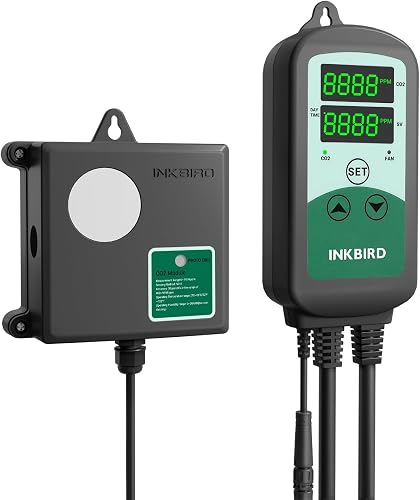
Inkbird ICC-510 CO2 Controller CO2 Meter Dual
Best for CO2 and ventilation - 6
 Check it
Mcbazel Digital Light Meter with HD Color
Best for LED lux comparisons
Which light meter for a grow tent fits each task?
The AquaHorti is the strongest fit for PAR mapping because it measures PAR, UVA, and separate blue, green, and red contributions. Its stored readings can help you compare several points across a canopy and identify uneven coverage.
Landtek is more flexible if you want PPFD alongside lux and foot-candle readings. Its grouped recording function and mounting thread can help with repeated measurements when the sensor needs to sit at canopy height.
Lux-only meters such as POROMETISTO and Mcbazel suit growers who mainly want to compare relative brightness under the same light. They can show whether one corner is dimmer than the center, but they cannot replace a PAR or PPFD reading.
The VIVOSUN and Inkbird products have supporting roles. VIVOSUN tracks temperature, humidity, and VPD, while Inkbird controls CO2 equipment and ventilation.
Neither is a light meter for measuring canopy intensity.
| Product | Best for | Light measurement | Spectrum detail | Recording | Our score |
|---|---|---|---|---|---|
| AquaHorti AH-Quantuv PAR Meter for Grow Lights | spectrum mapping | PAR and UVA | Separate blue, green, and red PAR | Up to 100 PAR measurements | 9.2 |
| Digital Handheld Illuminance Light Meter POROMETISTO | quick lux checks | 8.4 | |||
| Landtek PAR Meter for Grow Lights | dual light readings | PPFD, lux, and foot-candles | 4 sets of 25 readings | 7.5 | |
| VIVOSUN Digital Hygrometer Thermometer Indoor | tent climate | 7.6 | |||
| Inkbird ICC-510 CO2 Controller CO2 Meter Dual | CO2 and ventilation | 7.4 | |||
| Mcbazel Digital Light Meter with HD Color | LED lux comparisons | 7.3 |
How to choose the best light meter for grow tent use
Choose the measurement first, then consider the features that support your routine. PAR and PPFD meters provide plant-focused readings, while lux and foot-candle meters only show illuminance weighted for human vision.
PAR covers light used in photosynthesis, and PPFD measures photosynthetic photons reaching an area each second. Lux can help compare brighter and dimmer locations under the same lamp, but it does not give a PAR or PPFD value.
Choose AquaHorti when you want UVA plus separate blue, green, and red PAR readings. Landtek suits growers who want PPFD, lux, and foot-candle modes in one meter.
Also consider how you will measure. Data Hold, MAX/MIN readings, stored records, and a tripod thread can simplify repeated checks at canopy height, but only matter when they solve an access or record-keeping need.
POROMETISTO and Mcbazel are lux meters for location comparisons, not PPFD decisions. Mcbazel adds LED correction settings and a rotating head, while POROMETISTO has a backlit display and MAX/MIN mode.
The right choice depends on whether you need plant-light intensity, spectrum detail, relative brightness, or separate climate information.
The best light meters for grow tents
A PAR meter suits decisions that depend on photosynthetic light readings, while an illuminance meter can help find brighter and dimmer spots under a lamp. The products below are ordered by score.
AquaHorti AH-Quantuv PAR Meter for Grow Lights: Best for spectrum mapping
- Measures PAR from 400–750 nm
- Measures UVA from 320–400 nm
- Shows blue, green, and red PAR separately
- Stores up to 100 PAR readings
This meter combines PAR and UVA readings with a blue, green, and red breakdown. Its recording function can help map light levels across a tent.
Pros
- PAR and UVA modes
- Separate color-band readings
- Stores readings for distribution mapping
Cons
- Does not provide a stated lux mode
- No grow-area dimensions are given
The AquaHorti AH-Quantuv is the top pick if you want to map PAR and UVA and inspect the balance of blue, green, and red PAR. Its PAR range covers 400–750 nm, while its UVA range covers 320–400 nm.
That broader information suits growers who are adjusting light placement, comparing different areas of a tent, or trying to understand whether a fixture produces a different spectrum at the edges than at the center. It is also useful when a single total reading leaves too many questions about the light reaching the plants.
The separate color-band display gives more detail than one combined PAR figure. Blue, green, and red readings can be reviewed independently, although the meter does not turn those measurements into a plant-growth recommendation.
For coverage checks, the recording function stores up to 100 PAR measurements. Take readings across a consistent grid at canopy height, keeping the sensor orientation and height the same so the stored values can reveal hotspots or low-light zones.
Choose this meter when spectrum detail, UVA information, and a measurement log matter. It is less suitable if you only need a quick lux comparison and do not need separate PAR bands.
Digital Handheld Illuminance Light Meter POROMETISTO: Best for quick lux checks
- Measures 0–200,000 lux
- Data Hold and MAX/MIN modes
- Digital and analog bar graph display
- Samples 2 times per second
This handheld illuminance meter gives a broad lux range and MAX/MIN readings for comparing positions under a grow light. Lux readings are not PAR or PPFD readings.
Pros
- Broad lux range
- Data Hold and MAX/MIN functions
- Backlit display
Cons
- Does not measure PAR or PPFD
- Accuracy is specified under standard incandescent lamps
The POROMETISTO is a practical choice for comparing lux or foot-candles around a grow tent. Its range reaches 0–200,000 lux, covering dim indoor areas and bright positions close to a grow light.
The digital readout shows the current value, while the analog bar graph makes changing brightness easier to notice as you move between canopy positions. Data Hold freezes a reading in a narrow space, and MAX/MIN mode records the highest and lowest illuminance found during a check.
It samples twice per second and includes a backlit display for darker spaces. The compact handheld meter uses two included AA batteries, so it is ready to carry between measurement points.
This is an illuminance meter weighted for human vision. It does not report PPFD or PAR, and its stated accuracy applies under standard incandescent lamps.
Treat its results as relative brightness comparisons, not direct plant-light intensity.
Choose it when broad lux comparisons, a simple display, and portable operation are enough. Choose a PAR or PPFD meter when you need plant-focused readings.
Landtek PAR Meter for Grow Lights: Best for dual light readings
- Measures PPFD from 0–5,000 μmol/m²/sec
- Measures lux and foot-candles
- Logs 100 readings across 4 sets
- Has a 1/4-inch tripod thread
Landtek combines PPFD and illuminance readings with stored measurements. Its tripod thread can help position the sensor at canopy height.
Pros
- PPFD and lux modes
- Logs readings in separate sets
- Tripod or selfie-stick thread
Cons
- No UVA measurement is specified
- Its PAR range is narrower than the AquaHorti's stated wavelength range
Landtek combines PPFD, lux, and foot-candle modes in one handheld meter. Its stated PPFD range is 0–5,000 μmol/m²/sec, and its quantum sensor covers 400–700 nm.
That combination suits growers who want a plant-oriented reading for some checks but also want illuminance units for general comparisons. You can use the same instrument when checking a seedling area, comparing canopy positions, or reviewing how a lamp change affects the measured space.
The meter can store 100 readings in four sets of 25. It calculates minimum, maximum, and average values, giving each group a simple summary rather than requiring every result to be compared manually.
The grouped records can work well when you divide a tent into sections or measure separate sessions. Keep the height, orientation, and grid positions consistent so the stored averages describe comparable points rather than mixed conditions.
A Data Hold function freezes the value on screen, which helps when the display is hard to see while the sensor is positioned. The 1/4-inch thread supports a tripod or selfie-stick mount, helping you place the sensor at canopy height without reaching under the plants.
Choose Landtek if PPFD and illuminance readings belong in the same routine. Skip it if UVA readings or a separate blue, green, and red display are central to your comparison.
VIVOSUN Digital Hygrometer Thermometer Indoor: Best for tent climate
- Measures temperature and humidity
- Optional external sensor probe for dual-channel monitoring
- Bluetooth app access
- Records historical temperature and humidity data
This is a climate monitor, not a light meter. It can complement a grow-tent light meter by tracking temperature and humidity.
Pros
- Temperature and humidity readings
- Optional external probe
- Historical data storage
Cons
- Does not measure light
- Bluetooth app connection is required for remote monitoring
The VIVOSUN hygrometer thermometer tracks temperature and humidity, not light. It is therefore a supporting tool for a grow tent, not a replacement for a meter that reports lux, PAR, or PPFD.
Its built-in sensor can be paired with an external sensor probe for dual-channel monitoring. That setup can help you watch conditions in two locations, such as the main tent area and a separate space where temperature or humidity may differ.
The display includes temperature and humidity readings, highest and lowest records, and a visual VPD presentation. It also provides comfort-range indicators, which can make the current conditions easier to understand at a glance without opening the app.
Bluetooth connects the monitor to the Vivosun app. Through the app, you can view temperature, humidity, and VPD data remotely, receive notifications when conditions pass set limits, and review historical information stored for up to two years.
The monitor can be wall mounted, placed on its kickstand, or hung. Its operating humidity range is listed as 0–95%RH, and the temperature accuracy is listed as ±0.5°C.
Choose VIVOSUN when light readings are only one part of your routine and you also need climate information. It suits growers who want remote alerts or dual-channel monitoring, but it does nothing to measure canopy light.
Inkbird ICC-510 CO2 Controller CO2 Meter Dual: Best for CO2 and ventilation
- Controls CO2 equipment and ventilation
- Dual output design
- Light sensor adjusts CO2 output
This controller is not a light meter, but its light sensor can adjust CO2 output. Consider it only if you also need CO2 equipment and ventilation control.
Pros
- Dual output for CO2 equipment and ventilation
- Light sensor adjusts CO2 output
Cons
- Does not measure PAR, PPFD, or lux
- Requires compatible CO2 equipment and ventilation
The Inkbird ICC-510 is a CO2 controller with a light sensor, not a meter for mapping grow-light intensity. Its dual outputs connect CO2 equipment and a ventilation system so both can be managed together.
Its light sensor adjusts CO2 output according to light conditions. That supports control during the lighting cycle, but it does not measure canopy intensity or provide readings for a light-distribution map.
The controller accepts 100–240V AC and uses an LCD or LED display. It is a better fit for a managed greenhouse or grow room where CO2 delivery and exhaust control are already part of the setup.
The Inkbird does not report PAR, PPFD, or lux at individual plant positions. You cannot use it to compare the center of a tent with its corners.
Choose it when CO2 regulation and ventilation control are the goal, alongside a separate light meter. Skip it when you need to check light intensity, spectrum, or coverage.
Mcbazel Digital Light Meter with HD Color: Best for LED lux comparisons
- Measures 0–200,000 lux
- 270-degree right-side sensor rotation
- LED light-source correction coefficients
- Records MAX/MIN/average
This illuminance meter includes correction settings for several light sources and a rotating sensor head. Use it to compare lux across tent positions, not to read PPFD or PAR.
Pros
- LED correction coefficients
- Rotating sensor head
- MAX/MIN/average readings
Cons
- Does not measure PPFD or PAR
- Requires 3 AAA batteries, not included
The Mcbazel measures lux and foot-candles from 0–200,000 lux. It can compare illuminance between tent locations, but it does not provide PPFD or PAR readings.
Its correction coefficients include white, red, and warm LED settings. These can make comparisons more useful when they match your light source, although the result remains an illuminance measurement.
The sensor head rotates 270 degrees to the right, allowing it to face the lamp while the display faces you. This helps in tight spaces or when the fixture sits above the canopy.
The head turns right only. Do not force it left or past the stop, as that can damage the hinge.
MAX, MIN, and average functions summarize readings, while the 8-times-per-second sampling rate can capture changing light.
Accuracy is listed as ±(3%+5 Lux) under incandescent light and ±(6%+5 Lux) under other visible sources, including LEDs. Three AAA batteries are required and not included.
Choose Mcbazel for LED lux comparisons, a rotating sensor, and summary readings. Skip it when you need PPFD, PAR, or spectrum detail.
How do you map light across a grow-tent canopy?
Map light by taking readings at several points at the height of the canopy, using the same sensor orientation each time. A single center reading can't show whether the edges or corners receive much less light.
Start with a simple grid: center, corners, and points between them. The exact number of points depends on the size and shape of the canopy, but the useful comparison comes from measuring consistently, not from choosing a particular grid count.
Keep the sensor facing the light source and hold it level at each point. Avoid shading it with your hand or body, and don't change the sensor height as you move from the center to the edge.
Record each reading with its position. AquaHorti stores up to 100 PAR readings, and Landtek stores 4 sets of 25; if you use a meter without logging, write the location and value down as you go.
Use the first map as a baseline. If you adjust the lamp or change its height, repeat the same points and compare the readings, keeping the meter, orientation, and measurement height consistent.
What setup mistakes can distort light readings?
The most common mistake is comparing readings taken at different heights or angles. A sensor held near the lamp and then lower at the canopy is measuring different positions, so those values do not make a useful coverage comparison.
Another mistake is treating lux as interchangeable with PPFD or PAR. A lux meter can help find relative bright and dim spots under the same lamp, but it does not provide a plant-light reading, and comparisons across different light sources can be misleading.
Don't measure only the brightest center point. Include edges and corners so you can see how evenly light reaches the usable canopy area.
Keep your body and hands out of the sensor's path. A shadow from the person taking the reading can lower the value and make a spot appear dimmer than it is.
On the Mcbazel, rotate the sensor head to the right within its stated 270-degree movement. Don't force it in the opposite direction or beyond its stop.
Is lux enough for a grow tent?
Lux can help compare positions under the same grow light, but it is not a PPFD or PAR reading. Lux weights visible light for human vision, so two different light sources can produce similar lux values while their plant-relevant output differs.
For a quick map of brighter and dimmer tent areas, a lux meter can still be useful if you use the same lamp, sensor orientation, and height each time. If you need a plant-light measurement, choose a meter that specifically reports PAR or PPFD.
A lux meter is a sensible fit when your question is, “Which tent location is brighter under this setup?” A PAR or PPFD meter is the better fit when the number itself needs to represent photosynthetic light.
If light placement is only one part of your setup, how to use a soil moisture meter explains a separate way to check moisture around plant roots. For a broader comparison of moisture tools, see digital soil moisture meters and analog soil moisture meters.
How should you care for and use a grow-tent light meter?
Use the meter according to its controls and keep its sensor unobstructed while taking readings. A sensor cap is included with the POROMETISTO, so replace it when the meter is not in use.
Check the power needs before your first mapping session. AquaHorti and Landtek use 2 AAA batteries, POROMETISTO uses 2 AA batteries, and Mcbazel requires 3 AAA batteries that are not included.
Keep a simple record of the meter, light source, sensor height, and measurement positions used for each map. That makes later comparisons more useful, especially if you change the lamp position or want to repeat a previous check.
Use the Hold or logging functions to reduce transcription errors when working in tight spaces. For a tripod-mounted Landtek, confirm that the sensor is positioned at canopy height and faces the light before saving readings.
Which grow-tent light meter should you choose?
Choose AquaHorti when you want the most detailed plant-light information in this group. It measures PAR from 400–750 nm, UVA from 320–400 nm, and separate blue, green, and red PAR.
It also stores up to 100 PAR readings for mapping several canopy positions.
This is the strongest fit when one total light number is not enough. You can compare spectrum and PAR levels between the center and edges of a tent, then review the stored readings to find uneven coverage.
It is less suitable when you only want a quick lux comparison.
Choose Landtek if you want PPFD and illuminance modes together. It measures PPFD up to 5,000 μmol/m²/sec, plus lux and foot-candles.
Its four groups of 25 readings, along with minimum, maximum, and average calculations, can separate tent sections or measurement sessions.
Landtek also has a 1/4-inch thread for a tripod or selfie stick. That makes it easier to position the sensor at canopy height when plants block access to the back of the tent.
Pick POROMETISTO when lux comparisons are enough. It measures up to 200,000 lux, has a digital display and analog bar graph, samples twice per second, and includes Data Hold and MAX/MIN modes.
Its backlight helps in dark spaces, but it does not measure PAR or PPFD.
Choose Mcbazel for lux readings with a rotating sensor head and correction settings for white, red, and warm LEDs. Its head turns 270 degrees to the right, while MAX, MIN, and average functions help compare positions.
It remains an illuminance meter, not a plant-light meter.
Add VIVOSUN when temperature, humidity, VPD, and remote climate alerts matter too. Its built-in sensor can work with an external probe, and the app stores historical climate data.
It does not measure light.
Choose Inkbird only when CO2 and ventilation control are needed. Its light sensor adjusts CO2 output, but the controller does not report lux, PAR, or PPFD.
Start with the question you need answered. Choose PAR or PPFD when the reading must represent photosynthetic light or plant-facing intensity.
Choose lux when you only need to compare brightness under the same lamp, using consistent sensor height and orientation.
Our top 3 picks at a glance
-
1
Best for spectrum mapping
AquaHorti AH-Quantuv PAR Meter for Grow Lights
9.2/10 our score
See it on Amazon -
2
Best for quick lux checks
Digital Handheld Illuminance Light Meter POROMETISTO
8.4/10 our score
See it on Amazon -
3
Frequently asked questions
What kind of light meter is best for a grow tent?
A PAR or PPFD meter is the better choice when you need readings tied to plant light intensity. A lux meter can compare brightness from one canopy position to another, but lux is weighted for human vision and does not give a PPFD or PAR value.
Can a lux meter measure PPFD?
No. A lux meter reports illuminance in lux or foot-candles, while PPFD measures the number of photosynthetic photons reaching an area over time.
Lux can still help you compare locations under the same lamp, but it cannot replace a PAR or PPFD meter when you need those readings.
How do you map light coverage in a grow tent?
Take readings at a consistent height across a grid that covers the plant canopy. Keep the sensor in the same orientation at each point, then compare the values to spot brighter and dimmer areas.
Is a grow-tent climate monitor a light meter?
No. A climate monitor measures conditions such as temperature and humidity.
The VIVOSUN monitor in this guide can track those conditions, but it does not measure lux, PAR, or PPFD.
Use a separate light meter for light measurements.