9 Best Soil Moisture Meters for Outdoor Plants (October 2026)
The best soil moisture meters for outdoor plants include the XLUX Long Probe Plant Soil Moisture Meter for deep outdoor containers, the XLUX 2 Pack Long Probe Plant Soil for checking two garden zones, and the Gain Express Soil PH Meter for moisture and soil pH.
On this page (3 sections)
The XLUX Long Probe Plant Soil Moisture Meter is the best soil moisture meter for outdoor plants if you need a reading in a deep container. Choose the XLUX 2 Pack for separate garden areas or YAMRON for digital measurements of moisture, pH, temperature, and sunlight.
A dry surface doesn't always show the moisture around a plant's roots. A soil moisture meter for outdoor plants samples below the top layer to help you decide whether a container or bed needs water.
Use the reading as a guide, not a watering schedule. Soil type, drainage, recent rain, and plant needs still matter.
Our picks at a glance
-
1
 Best for deep outdoor containers
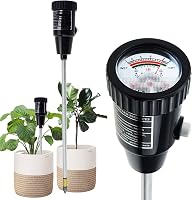
XLUX Long Probe Plant Soil Moisture Meter
9.7/10 our score
See it on Amazon -
2
 Best for checking two garden zones
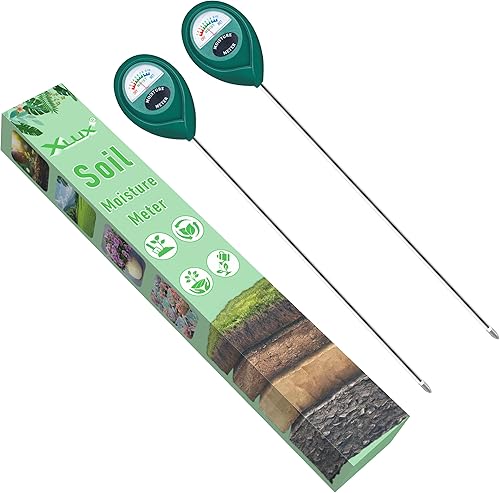
XLUX 2 Pack Long Probe Plant Soil
9.6/10 our score
See it on Amazon -
3

- 4
 Check it
Gouevn 2pack Soil Moisture Meter
Best for lawn and container checks - 5
 Check it
YAMRON 4-in-1 Soil Moisture Meter Digital Plant
Best for digital garden readings - 6
 Check it
Tennedriv Green Long Probe Soil Moisture Meter
Best for deep-rooted outdoor plants - 7
 Check it
XLUX Orange 2 Pack Soil Moisture Meter
Best for quick checks across the yard - 8
 Check it
Dr.meter 2 Packs Soil Moisture Meter Tester
Best for simple two-point checks - 9
 Check it
EDGEVEIL 4-in-1 Soil Moisture Meter for Plants
Best for remote multi-plant monitoring
Best soil moisture meters for outdoor plants by use
The XLUX long-probe model is the top pick for deeper containers, while multi-packs suit checking separate beds and pots. Choose a digital model if additional soil and light measurements will help your routine.
XLUX Long Probe Plant Soil Moisture Meter: Best for deep outdoor containers
- 5.5 in longer probe
- Battery-free
- Large dial with 3 zones and 10 scales
- Single probe
The extended probe can reach deeper soil in large pots, and the dial gives an immediate moisture reading. Its single-probe design causes less damage to plant roots than double or multiple probes.
Pros
- Long probe for deeper pots
- Immediate dial reading
- Single-probe design
Cons
- Not for very hard soil or liquids
- Remove within 5 minutes and wipe clean
XLUX suits large outdoor containers where the top inch can dry before the lower root area does. The probe is 5.5 in longer than regular styles, and the dial immediately shows dry, moist, or wet across three zones and ten scales.
Its single probe is designed to cause less root damage than double or multiple probes. After checking, remove the meter and wipe the probe clean.
XLUX cautions against leaving it in the soil for more than 5 minutes because the metal tip may corrode.
This meter is designed for standard potting soil. In loose mixes such as pure perlite, pumice, pine bark, or orchid mix, press the material around the probe to improve contact with moisture-holding particles.
For a bed, take readings at multiple spots rather than assuming one point represents the whole area. Read our guide to what a soil moisture sensor can tell you before deciding how much weight to give one measurement.
XLUX 2 Pack Long Probe Plant Soil: Best for checking two garden zones
- 2 meters
- 5.5 in longer probes
- Battery-free
- Large dials with 3 zones and 10 scales
Two long-probe meters let you check separate containers or garden areas without carrying one gauge from place to place. Each has an immediate analog readout.
Pros
- Two meters in the pack
- Long probes reach deeper soil
- No batteries required
Cons
- Not for very hard soil or liquids
- Remove within 5 minutes and wipe clean
The XLUX 2 Pack suits gardeners who want to check a group of containers and a separate bed. Both meters have the extended probe and immediate dial reading of the single XLUX pick.
Each meter uses a single probe and a dial with three zones and ten scales. They need no batteries for quick spot checks.
Like the single pack, these are for soil, not water or other liquids. Avoid very hard soil, remove each meter after taking a reading, and wipe the probe clean.
Choose this set when you routinely check more than one planting area. For help getting consistent readings, see how to use a soil moisture meter.
Gain Express Soil PH Meter: Best for moisture and soil pH
- Measures soil moisture and pH
- 295 mm electrode
- Self-powered
- Waterproof metal probe
The long electrode and combined moisture and pH readings suit gardeners who want to check more than watering needs. Gain Express recommends periodic calibration.
Pros
- Moisture and pH in one tool
- Long electrode for deeper soil
- Self-powered
Cons
- Operating temperature range is 5 to 50 °C
- Calibration is recommended periodically
Gain Express suits gardeners who want moisture and soil pH readings from one tool. Its 295 mm electrode is longer than a short pot probe, and the meter does not require batteries.
The combined readings can be useful when you are checking a lawn, garden, orchard, or field planting. Gain Express recommends periodic calibration and gives an operating temperature range of 5 to 50 °C.
This tool measures pH as well as moisture, so it adds a second question to a basic watering check. If pH is the main concern, compare it with our guide to soil pH and moisture meters.
Gouevn 2pack Soil Moisture Meter: Best for lawn and container checks
- 2 meters
- 7.7 in long probe
- Battery-free
- Large dial
The two meters and 7.7 in probes suit a mix of lawn, garden, and container checks. The large dial gives a quick moisture reading without batteries.
Pros
- Two meters for separate areas
- Long probe
- Indoor and outdoor use
Cons
- Do not leave in soil for a long time
- Not for testing liquids
Gouevn's two meters suit mixed outdoor use, such as checking a lawn and a few large containers. The 7.7 in long probe reaches soil below the surface, and its large dial gives a quick reading without batteries.
The single-probe design is intended to come out without pulling much soil or disturbing roots. Gouevn advises using it only in soil and not leaving it inserted for a long time.
A two-meter pack can make routine checks more convenient when planting areas are spread out. For small indoor containers, see our picks for the best soil moisture meter for indoor plants.
YAMRON 4-in-1 Soil Moisture Meter Digital Plant: Best for digital garden readings
- Measures moisture, pH, temperature, and sunlight
- Backlit LCD
- Insert probe about 4 in
- 45-degree rotating head
The digital display combines four readings for gardeners who want soil and light information in one tool. YAMRON's instructions say to insert the probe about 4 in and wait 10 seconds.
Pros
- Four types of readings
- Backlit display
- Rotating head
Cons
- Requires 4 AAA batteries
- Avoid dry, hard soil and liquids
YAMRON is the digital pick for gardeners who want moisture, pH, soil temperature, and sunlight readings on one backlit LCD. Its instructions call for inserting the probe about 4 in into soil, waiting 10 seconds, and sampling at least five locations for pH and moisture.
The head rotates from 0 to 45 degrees, which can make it easier to read over a raised bed or container. It uses four AAA batteries, which are not included.
YAMRON cautions against dry, hard soil and liquids. Its instructions say to water a dry test area and wait 10 minutes before taking a measurement, so this model takes more steps than a simple analog meter.
Tennedriv Green Long Probe Soil Moisture Meter: Best for deep-rooted outdoor plants
- Long probe
- Battery-free
- Large gauge
- Indoor and outdoor use
The long probe is intended to reach the root zones of plants with deeper root systems. Insert it for a reading, then wipe the probe after removing it.
Pros
- Long probe for deeper roots
- Easy-to-read gauge
- No batteries required
Cons
- Do not leave it in soil
- Do not insert it into water
Tennedriv Green is a long-probe option for outdoor plants with deeper roots. Insert it into the soil, read the large gauge, then wipe the probe after removing it.
It requires no batteries and is described for indoor and outdoor use. Avoid leaving it in the soil or placing it in a cup of water.
Consider it when you want a simple meter for checking a deep container without extra pH or light functions. It focuses on moisture readings, while the digital combination meters add other measurements.
XLUX Orange 2 Pack Soil Moisture Meter: Best for quick checks across the yard
- 2 meters
- Battery-free
- Large dials with 3 zones and 10 scales
- Single probe
Two meters give you a simple way to check separate garden beds or containers. The large dial shows moisture immediately after you insert the single probe.
Pros
- Two meters in the pack
- Clear three-zone dial
- Single-probe design
Cons
- Not for very hard soil or liquids
- Remove within 5 minutes and wipe clean
The XLUX Orange 2 Pack gives you two analog meters for checks across outdoor containers and beds. Its large dial has three zones and ten scales, and the single-probe design is intended to cause less damage to plant roots than double or multiple probes.
The immediate readout makes it easy to compare a few spots in the garden. As with the other XLUX analog meter here, avoid very hard soil and liquids, remove it within 5 minutes, then wipe the probe.
This is a practical choice if you prefer a simple dial and want more than one meter available. It does not add pH, temperature, or sunlight measurements.
Dr.meter 2 Packs Soil Moisture Meter Tester: Best for simple two-point checks
- 2 meters
- 10-scale color-coded readout
- Battery-free
- Single probe
The two meters help cover different outdoor planting areas, and the color-coded scale is designed to make readings easy to interpret. Each uses a single probe.
Pros
- Two meters in the pack
- Color-coded 10-scale interface
- No batteries required
Cons
- Not for liquids or extremely hard soil
- Clean the probe after each use
Dr.meter's two-pack suits straightforward moisture checks across separate planting areas. Each meter has a 10-scale color-coded interface and a single probe, and the pair needs no batteries.
The color pattern runs from red through green to blue, giving you a visual way to interpret the scale. Dr.meter advises keeping the probe away from rocks and extremely hard soil, using it only in soil, and cleaning it after each reading.
Choose this set if you want two basic meters and a colored dial. For a screen-based comparison, see the best digital soil moisture meters.
EDGEVEIL 4-in-1 Soil Moisture Meter for Plants: Best for remote multi-plant monitoring
- Moisture, temperature, light, and clock display
- Wireless range up to 328 ft
- Connects with up to 12 sensors
- 2 AAA batteries included
EDGEVEIL is designed for remote checks from one display, and one display can connect with up to 12 sensors. Its wireless range is stated as up to 328 ft.
Pros
- Remote viewing from a central display
- Four readings shown together
- Can connect up to 12 sensors
Cons
- Uses batteries
- Higher setup complexity than a simple dial meter
EDGEVEIL suits gardeners who want to check multiple plants from a central display. It shows moisture, temperature, light, and a clock, and its wireless range is up to 328 ft.
One display can connect with up to 12 sensors, which may help when beds and containers are spread across a yard. The package includes two AAA batteries, and EDGEVEIL describes the probe as designed for continuous monitoring.
This option has more setup and functions than a handheld dial meter. Consider it when remote checks matter more than a simple, battery-free spot reading.
How to choose an outdoor soil moisture meter
The best outdoor soil moisture meter depends on probe reach, the number of planting areas, and whether you want extra readings. Start with where the roots sit, then decide whether a basic dial or digital display fits your routine.
Is a long probe useful for outdoor plants?
A long probe can reach deeper soil in larger pots and around deeper root zones. XLUX describes its probe as 5.5 in longer than regular styles, while Gouevn gives its probe length as 7.7 in.
For raised beds, sample at several locations and depths if the bed dries unevenly. Do not force a probe into compacted soil or past rocks.
Should you choose analog or digital?
Analog meters give an immediate dial reading and do not need batteries in these picks. Digital meters can add pH, temperature, and light measurements, but may require batteries and extra steps.
YAMRON provides four types of readings on a backlit screen. Gain Express measures moisture and pH, while EDGEVEIL is designed for remote monitoring through a separate display.
How should you read moisture after rain?
Wait until water has had time to drain through the soil before using the reading to guide the next watering. Check more than one spot, especially in large beds or containers with uneven exposure.
Use the meter alongside rainfall information when planning irrigation. A weather station for a solar PV plant covers weather monitoring for a different setup, but outdoor rain and temperature context can help explain changing garden conditions.
Which outdoor soil moisture meter should you pick?
Choose the XLUX Long Probe Plant Soil Moisture Meter for deep containers and simple readings, the XLUX 2 Pack for separate garden zones, or YAMRON if you want digital soil and light measurements. For remote checks across several plants, EDGEVEIL offers a central display and expandable sensors.
Whatever model you choose, take readings in more than one spot and remove handheld probes after each check. That gives you a better view of the root zone than judging soil by its surface alone.
Our top 3 picks at a glance
-
1
Best for deep outdoor containers
XLUX Long Probe Plant Soil Moisture Meter
9.7/10 our score
See it on Amazon -
2
Best for checking two garden zones
XLUX 2 Pack Long Probe Plant Soil
9.6/10 our score
See it on Amazon -
3
Frequently asked questions
What type of soil moisture meter works for outdoor plants?
A long-probe meter is useful when you need to check below the dry surface layer in a deep container or garden bed. For simple checks, an analog dial is easy to read, while digital models can add readings such as pH, temperature, or light.
Choose based on the soil depth and information you need.
Can I leave a soil moisture meter in a garden bed?
Most simple probe meters here are intended for short readings, then removal and cleaning. XLUX says not to leave its meter in soil for more than 5 minutes, and Tennedriv also cautions against leaving its meter in soil.
Follow the specific instructions for your meter.
How deep should I insert an outdoor soil moisture meter?
Insert the probe far enough to sample the root zone, while avoiding rocks and very hard soil. YAMRON specifies about 4 in for its digital meter, while XLUX's longer probe is designed to reach deeper soil in larger pots.
Use readings from several locations when a bed has uneven moisture.
Are digital soil moisture meters better for outdoor plants?
Digital meters are useful if you want more than a moisture indication, such as pH, temperature, or light. A basic analog meter avoids batteries and gives a direct dial reading.
Pick the display and extra measurements that match how you garden, and treat readings as one input alongside soil feel and plant needs.