9 Best Wi-Fi Temperature Sensors with Alerts (November 2026)
The best Wi-Fi temperature sensors with alerts include the SwitchBot WiFi Thermometer Hygrometer 3 Pack for monitoring several rooms, the Ideal Sciences Temp Stick Remote WiFi Temperature for text alerts, and the MOCREO WiFi Thermometer Freezer Alarm for fridge and freezer alerts.
On this page (4 sections)
The best Wi-Fi temperature sensor with alerts for several spaces is the SwitchBot WiFi Thermometer Hygrometer 3 Pack, with three sensors, a Hub Mini, and app alerts for temperature and humidity. Temp Stick suits buyers who want text alerts, while MOCREO offers freezer kits with local hub alarms.
Start by deciding what you need to protect and how you want to hear about a change. A basement sensor, freezer probe, and greenhouse monitor have different placement, connection, and alert needs.
For a single remote sensor, compare our best remote temperature sensors. If you plan to place a sensor outside, see the guide to outdoor Wi-Fi temperature sensors.
Our picks at a glance
-
1
 Best for monitoring several rooms
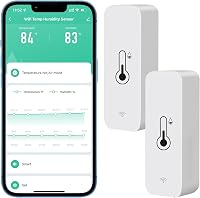
SwitchBot WiFi Thermometer Hygrometer 3 Pack
9.6/10 our score
See it on Amazon -
2
 Best for text alerts
Ideal Sciences Temp Stick Remote WiFi Temperature
9.5/10 our score
See it on Amazon -
3
 Best for fridge and freezer alerts
MOCREO WiFi Thermometer Freezer Alarm
9.5/10 our score
See it on Amazon
- 4
 Check it
MOCREO WiFi Remote Thermometer Freezer Alarm
Best for long-range placement - 5
 Check it
GoveeLife 2.0 WiFi Hygrometer Thermometer with Gateway
Best for room temperature and humidity - 6
 Check it
NECTO Cellular Temperature Monitor
Best where Wi-Fi is unavailable - 7
 Check it
MOCREO WiFi Freezer Thermometer with Alarm
Best for a simple freezer setup - 8
 Check it
GoveeLife WiFi Refrigerator Thermometer Sensor with Alarm
Best for a refrigerator probe - 9
 Check it
pp-Code WiFi Temperature and Humidity Sensor
Best for a powered indoor space
Which Wi-Fi temperature sensors with alerts suit each use?
The right choice depends on where the sensor will go, how many readings you need, and which alert will reach you in time. These nine picks cover multiple rooms, cold storage, equipment spaces, and locations without Wi-Fi.
We compared sensor counts, alert options, power, placement, and connection requirements. The scores reflect how well each set of features matches the needs of someone shopping for a Wi-Fi temperature sensor with alerts.
| Product | Best for | Sensors | Alert method | Placement | Our score |
|---|---|---|---|---|---|
| SwitchBot WiFi Thermometer Hygrometer 3 Pack | monitoring several rooms | 3 | App notifications | Indoor and outdoor | 9.6 |
| Ideal Sciences Temp Stick Remote WiFi Temperature | text alerts | Text and email | 9.5 | ||
| MOCREO WiFi Thermometer Freezer Alarm | fridge and freezer alerts | 2 | App, email, and hub alarm | 9.5 | |
| MOCREO WiFi Remote Thermometer Freezer Alarm | long-range placement | 2 | App, email, and hub alarm | 9.3 | |
| GoveeLife 2.0 WiFi Hygrometer Thermometer with Gateway | room temperature and humidity | 3 | App and email | 8.9 | |
| NECTO Cellular Temperature Monitor | where Wi-Fi is unavailable | Text and email | 8.8 | ||
| MOCREO WiFi Freezer Thermometer with Alarm | a simple freezer setup | 1 | App, email, and hub alarm | 8.1 | |
| GoveeLife WiFi Refrigerator Thermometer Sensor with Alarm | a refrigerator probe | 1 | App, email, and buzzer | 8.0 | |
| pp-Code WiFi Temperature and Humidity Sensor | a powered indoor space | Email and optional text | 7.9 |
The best Wi-Fi temperature sensors with alerts
The SwitchBot 3-pack is the strongest fit for monitoring several spaces, while Temp Stick and the MOCREO freezer kit offer distinct alert setups. The products appear in score order.
SwitchBot WiFi Thermometer Hygrometer 3 Pack: Best for monitoring several rooms
- 3 sensors and Hub Mini
- App alerts for temperature and humidity changes
- Dew point, VPD, and absolute humidity readings
- IP65 dustproof and waterproof
Three sensors and a Hub Mini let you monitor several places, with app alerts for preset temperature and humidity limits. Its IP65 rating supports indoor or outdoor placement.
Pros
- 3 sensors included
- IP65 dustproof and waterproof
- Stores and exports data
Cons
- Remote monitoring requires the included Hub Mini
SwitchBot includes three sensors and one Hub Mini, making it useful when you want readings from several rooms or storage areas. Set app alerts for temperature and humidity limits, then place the sensors where changes could matter, such as a basement, greenhouse, or refrigerator.
Along with temperature and humidity, the sensors report dew point, VPD, and absolute humidity. Those readings help you follow moisture conditions in places such as a wine cellar, instrument case, or greenhouse.
The sensors are rated IP65 for dust and water resistance, so they can suit indoor or outdoor placements. The Hub Mini enables remote monitoring and voice commands through Alexa, Google Home, Siri Shortcuts, and SmartThings.
Choose SwitchBot if you need several sensors and want humidity-related readings as well as temperature. Skip it if you only need one reading point or want text alerts as your main notification.
Ideal Sciences Temp Stick Remote WiFi Temperature: Best for text alerts
- Unlimited text and email alerts
- Monitors temperature and humidity
- No subscription
- 2 AA batteries
Temp Stick sends text or email alerts when temperature or humidity crosses set thresholds. It works with 2.4 GHz Wi-Fi and needs no gateway.
Pros
- Unlimited text and email alerts
- No subscription
- Offline data uploads after reconnection
Cons
- Does not support 5 GHz Wi-Fi
- Not for public or guest Wi-Fi networks
Temp Stick is the clear pick for unlimited text and email alerts without a subscription. It monitors temperature and humidity, and you can set several alert thresholds for different conditions.
It connects to 2.4 GHz Wi-Fi without a gateway and runs on 2 AA batteries. If the connection drops temporarily, it can store readings and upload them when it reconnects.
The sensor can also alert you to a lost internet connection or low batteries, and it works with Alexa and IFTTT. It won't work with 5 GHz Wi-Fi or public and guest networks, so confirm your network before choosing it.
Buy Temp Stick if you want direct text alerts and have a compatible private Wi-Fi network. Skip it if you need multiple sensors in the box or a loud alarm in the room.
MOCREO WiFi Thermometer Freezer Alarm: Best for fridge and freezer alerts
- 2 wireless temperature sensors and Wi-Fi hub
- App, email, and 90 dB hub alerts
- Temperature range from -40°F to 158°F
- CSV data export
Two sensors can monitor a refrigerator and freezer, with app and email notifications plus a 90 dB hub alarm. The hub can connect to up to 30 MOCREO BLE sensors.
Pros
- 3 alert methods
- 2 sensors included
- CSV export for 2 years
Cons
- Supports 2.4 GHz Wi-Fi only
This MOCREO kit is built for refrigerator and freezer monitoring, with two wireless sensors and a Wi-Fi hub. It sends app and email notifications, and the hub sounds a 90 dB alarm when readings exceed your chosen limits.
The sensors cover -40°F to 158°F and use thin probe cables that can pass through refrigerator door seals. The hub can connect to up to 30 compatible MOCREO BLE sensors, which gives you a way to add more monitoring points later.
The system can also report a hub going offline or a low battery. It uses 2.4 GHz Wi-Fi, and the sensors take replaceable AAA batteries.
Choose this kit if you want to monitor two cold-storage spaces and hear an alarm at home. Skip it if you need an LCD display on the hub or stronger reach across a large property.
MOCREO WiFi Remote Thermometer Freezer Alarm: Best for long-range placement
- 2 wireless temperature sensors and H5Pro hub
- App, email, and 95 dB hub alerts
- IP66 splash-proof sensors
- Open-air wireless range up to 1,640 ft
The H5Pro hub displays readings and communicates with compatible sensors at an open-air range of up to 1,640 ft. App, email, and hub alerts cover changes that cross your set limits.
Pros
- IP66 splash-proof sensors
- Hub has an LCD display
- CSV data export for 2 years
Cons
- Metal enclosures can interfere with wireless signals
The MOCREO H5Pro set suits a garage, greenhouse, or other area where the sensor may sit far from the hub. Its stated open-air range reaches up to 1,640 ft, and the kit includes two IP66 splash-proof sensors and an LCD hub.
Alerts can come through the app, by email, or as a 95 dB hub beep. The hub connects by Ethernet or 2.4 GHz Wi-Fi and can communicate with up to 100 compatible sensors in open air.
The sensors cover -4°F to 131°F, and the system supports CSV export of two years of data. Avoid fully enclosed metal containers because they can interfere with the wireless signal.
Choose it if you want a display at the hub, splash-proof sensors, and long open-air reach. Skip it if the sensors must sit inside a metal enclosure or if the location has walls and obstacles that make range uncertain.
GoveeLife 2.0 WiFi Hygrometer Thermometer with Gateway: Best for room temperature and humidity
- 3 sensors and Wi-Fi gateway
- App and email alerts
- Temperature accuracy ±0.54°F
- Supports up to 10 sensors
This 3-sensor kit tracks temperature and humidity around indoor spaces. The gateway sends app and email alerts when readings cross preset limits.
Pros
- 3 sensors included
- App and email notifications
- Data export for 2 years
Cons
- Requires a compatible gateway for remote alerts
GoveeLife’s three-sensor kit tracks indoor temperature and humidity through a Wi-Fi gateway. Set app limits and receive app and email alerts when a reading moves outside them.
The sensors have a stated temperature accuracy of ±0.54°F, and the gateway supports up to 10 compatible sensors. The app shows trend data for the past 20 days and lets you export up to two years of data.
The kit includes three sensors and a gateway, and the sensors have lanyards for hanging in drawers, wine cabinets, or other small spaces. The gateway needs a 2.4 GHz Wi-Fi network for remote monitoring.
Choose this GoveeLife set for several indoor rooms where temperature and humidity both matter. Skip it if you need a loud local freezer alarm, or want sensors rated for outdoor use.
NECTO Cellular Temperature Monitor: Best where Wi-Fi is unavailable
- Cellular monitoring
- Temperature, humidity, and power outage alerts
- 2 years of cellular service included
- Rechargeable internal battery
NECTO uses cellular service instead of Wi-Fi to send remote temperature, humidity, and power loss alerts. It includes 2 years of cellular service and a rechargeable battery.
Pros
- Does not require Wi-Fi
- Power outage alerts
- Up to 5 alert contacts
Cons
- Cellular service renews after the included 2 years
NECTO is the choice for a location without dependable Wi-Fi because it uses 4G LTE cellular service. It monitors temperature, humidity, and power loss, then sends text or email alerts to as many as five contacts.
Two years of cellular service are included. Its rechargeable internal battery can run for up to three days, allowing it to keep monitoring during a power outage.
NECTO reads conditions every 10 seconds, updates its online portal every 10 minutes, and stores readings for one year. You can download the stored readings as a CSV file.
Choose NECTO for an RV, car, or other place where Wi-Fi isn't available and power loss matters. Skip it if you want a sensor that runs on Wi-Fi or don't want to plan for cellular service renewal after the included period.
MOCREO WiFi Freezer Thermometer with Alarm: Best for a simple freezer setup
- H3 Wi-Fi hub and 1 temperature sensor
- App, email, and 80 dB hub alerts
- Temperature range from -40°F to 257°F
- Supports up to 30 sensors
This one-sensor kit combines a probe with an H3 hub that sounds an 80 dB alarm. It suits a single fridge or freezer and can expand to support more compatible sensors.
Pros
- 3 alert methods
- Hub supports up to 30 sensors
- Data export for 2 years
Cons
- Indoor use only
This MOCREO set is a simple option for one refrigerator or freezer. It combines one probe sensor with an H3 Wi-Fi hub, which can sound an 80 dB alarm and send app and email alerts.
The sensor covers -40°F to 257°F, and the hub supports up to 30 compatible sensors. That expansion option is useful if you expect to add coverage later, but one sensor is enough to start monitoring a single appliance.
The hub plugs into an outlet, and the sensor uses AAA batteries. The kit works with 2.4 GHz Wi-Fi and supports two years of data export.
Choose it if you need one cold-storage sensor with a local alarm. Skip it if you need several sensors immediately or want a system designed for outdoor placements.
GoveeLife WiFi Refrigerator Thermometer Sensor with Alarm: Best for a refrigerator probe
- Gateway and 1 thermometer sensor
- App, email, and buzzer alerts
- Temperature range from -40°F to 158°F
- Supports up to 10 sensors
A gateway and probe sensor provide remote monitoring for a refrigerator or freezer. App, email, and buzzer alerts respond to readings outside your preset range.
Pros
- 3 alert methods
- Supports up to 10 sensors
- Magnetic back and probe holder
Cons
- The buzzer is muted by default
GoveeLife’s single-sensor kit includes a gateway and offers app, email, and buzzer alerts. Set a temperature range for a refrigerator or freezer and receive a remote warning or hear the local alarm when readings move outside it.
The sensor covers -40°F to 158°F and uses a probe with a holder to keep the cable tidy. The gateway supports up to 10 sensors, so you can add more monitoring points across refrigerators, freezers, or rooms.
The gateway uses 2.4 GHz Wi-Fi and Bluetooth. The buzzer is muted by default, so turn it on during setup if you want an audible warning.
Choose it for a single appliance where you want a probe and local buzzer. Skip it if you want multiple sensors in the starter kit; for other Govee options, see our Govee Wi-Fi temperature sensor guide.
pp-Code WiFi Temperature and Humidity Sensor: Best for a powered indoor space
- Temperature and humidity monitoring
- Email alerts and optional text alerts
- 2.4 GHz Wi-Fi
- Powered by charger
This powered sensor monitors indoor temperature and humidity in spaces such as server rooms, labs, and greenhouses. Email alerts are available, while text alerts require a subscription.
Pros
- No batteries required
- Email alerts
- Portal logs can be downloaded
Cons
- Text alerts require a subscription
The pp-Code sensor suits a fixed indoor space with a nearby outlet, such as a server room, lab, greenhouse, or pet area. It monitors temperature and humidity over 2.4 GHz Wi-Fi and sends email alerts through its portal.
The sensor runs on its included charger, so you don't need to replace batteries. The portal stores logs for download and can send text alerts, but that option requires a subscription.
It reads conditions every minute and logs them hourly. A sudden temperature change of 5°F or more triggers an immediate portal update, and the local web interface and API may suit buyers who want direct access to readings.
Choose pp-Code for a powered location where you want logs and email warnings. Skip it if you need battery operation, a hub alarm, or placement without a nearby outlet.
How do you choose a Wi-Fi temperature sensor with an alarm?
Choose the sensor by matching its alert method, network, and placement to the risk you want to watch. A remote notification is useful only if the sensor can reach its network and you can receive the warning.
Which alert types should you prioritize?
Choose the alert channel you are most likely to notice and act on. App notifications work well if you check your phone, while text and email provide other ways to receive a warning; a local buzzer can help someone at home hear it.
Check whether alerts cover low batteries, lost connections, or power loss as well as temperature. If you depend on alerts while away, an offline warning can tell you when the monitor itself stops reporting.
Do you need a probe or a separate sensor?
A probe lets you put the sensing tip inside an appliance while keeping the hub or radio unit outside. A standalone sensor is simpler for placing on a shelf or in a room.
If you need a probe, compare Wi-Fi temperature sensors with probes. For a plain explanation of the readings these devices can provide, see what a temperature and humidity sensor measures.
Will the sensor connect from its planned location?
Check whether your Wi-Fi is 2.4 GHz, whether a hub is required, and how far the sensor will be from the hub or router. A published open-air range can shrink around walls, appliances, and metal enclosures.
For outdoor placement, choose a sensor with a stated protection rating and review our guide to outdoor Wi-Fi temperature sensors. For water on the floor, use a dedicated water detector and alarm because temperature sensors don't detect leaks.
How many sensors and readings do you need?
Count each place you want to monitor before buying. A kit with three sensors can cover several rooms at once, while a one-sensor probe may be a better fit for a single freezer.
Decide whether humidity, dew point, or other readings matter alongside temperature. If they don't, a simpler thermometer may be easier to set up and understand.
What should you check before setup?
Confirm the Wi-Fi band, hub requirements, power source, and alert methods before pairing devices. For a hub-based system, plan where the hub will sit and make sure it can reach both the router and sensors.
Set high and low limits that match the space instead of copying a generic threshold. A freezer, greenhouse, and pet area have different needs, and a limit set too narrowly can cause repeated alerts for ordinary fluctuations.
How can you keep alerts useful?
Use a threshold that gives you time to respond, then check that each alert channel is enabled. If the hub has a buzzer, test the sound and make sure you know how to silence it.
Review battery status and connection alerts periodically, especially after moving a sensor or changing a router. Keep probe cables arranged so they don't interfere with an appliance door seal.
What common mistakes should you avoid?
Don't assume every sensor connects directly to Wi-Fi: some require a gateway or hub. Don't assume an outdoor rating means every part of a kit, including its hub, can stay outside.
Avoid placing a sensor behind a metal barrier or beyond the hub's practical range. Also avoid relying on one alert method without confirming it is enabled, reachable, and appropriate for when you're away.
Which Wi-Fi temperature sensor with alerts should you pick?
Pick SwitchBot for three sensors and readings beyond temperature, Temp Stick for unlimited text alerts, or MOCREO for freezer monitoring with a local hub alarm. Choose NECTO if the location has no Wi-Fi and you want cellular alerts.
Before buying, match the number of sensors, probe style, network, and alert channels to the space. For more options across different placements, start with our best remote temperature sensors guide.
Our top 3 picks at a glance
-
1
Best for monitoring several rooms
SwitchBot WiFi Thermometer Hygrometer 3 Pack
9.6/10 our score
See it on Amazon -
2
Best for text alerts
Ideal Sciences Temp Stick Remote WiFi Temperature
9.5/10 our score
See it on Amazon -
3
Best for fridge and freezer alerts
MOCREO WiFi Thermometer Freezer Alarm
9.5/10 our score
See it on Amazon
Frequently asked questions
What should a Wi-Fi temperature sensor alert you about?
Set high and low temperature limits that match what you need to protect. A freezer sensor should warn when the temperature rises too far, while a greenhouse sensor should flag conditions outside your target range.
Some systems also report low batteries, lost connections, or power loss, which can alert you when monitoring is interrupted.
Do Wi-Fi temperature sensors need a hub?
Some sensors connect through a hub that links them to your Wi-Fi, while others connect to the network directly. Confirm that the kit includes its hub and that the sensor can reach it from the planned location.
A hub may also provide a local screen or audible alarm, so decide whether you need alerts at home as well as on your phone.
Can a Wi-Fi temperature sensor work without internet?
Remote app alerts generally need an internet connection. Some systems can sound a local alarm when a reading crosses its limit or store readings for upload after connection returns.
Check what happens during a Wi-Fi or power outage before relying on a sensor to protect a freezer, pet area, or equipment.
Can I use a Wi-Fi temperature sensor outdoors?
Choose a sensor with a stated protection rating for the location. The SwitchBot kit is rated IP65 for dust and water resistance, and the MOCREO H5Pro kit's sensors are rated IP66 for splash resistance.
Keep the sensor within its hub or network range, and remember that walls and metal enclosures can affect wireless communication.
Are Wi-Fi temperature sensors useful for water leaks?
A temperature sensor can warn about cold conditions near pipes, but it won't detect water on the floor. For that job, choose a dedicated water detector and alarm that senses leaks directly.