How to Read a Rain Gauge
To learn how to read a rain gauge, line up your eyes with the water and read the scale at the bottom of its curve. Record the amount and time, then empty the gauge for a fresh interval.
On this page (9 sections)
- How do you read a rain gauge scale?
- How do you choose a rain gauge for your needs?
- Where should you place a rain gauge?
- What common mistakes make readings less useful?
- What should you do if the gauge is hard to read?
- What if the water is above the scale or the gauge overflowed?
- How do manual and digital rain readings differ?
- How should you record and compare rainfall?
- How should you read a rain gauge and choose the right type?
To learn how to read a rain gauge, look across the water at eye level and read the scale at the bottom of the curved surface. Record the amount and time, then empty the tube if you want the next reading to cover a new period.
A manual gauge measures water collected over an interval. The reading is most useful when the gauge stays upright in the same open spot and you check it on a regular schedule.
How do you read a rain gauge scale?
Read the scale where the bottom of the water’s curve meets the markings. Looking straight across at eye level helps prevent a high or low reading caused by viewing angle.
The curved surface is called a meniscus. For water in a clear tube, use the bottom of that curve rather than its upper edge.
Check the gauge’s scale before taking a reading. Some tubes mark tenths of an inch, while others use different divisions, so count the smallest marked units instead of estimating from the tube’s height.
If the water falls between two marks, note the closest readable amount and use the same rounding approach each time. Don’t tilt the tube to move the water toward the scale.
Our guide to what a rain gauge measures and how it works explains how the instrument collects rain.
How do you read a rain gauge with a floating marker?
Read the marker’s water level against the tube scale, following the gauge’s instructions. A floating marker can make the level easier to spot, but the scale still determines the rainfall amount.
The JMBay Rain Gauge Outdoor has a bold scale, colored strip, and red floating buoy. Its removable tube can be taken out for checking and emptying.
Keep the gauge vertical while reading it. If the marker sticks or the water is cloudy, check the tube and follow its care instructions rather than guessing.
How do you choose a rain gauge for your needs?
Choose a manual gauge for direct readings and a digital weather station when you want rainfall history with other weather information. Also consider whether the scale is easy to see, the tube is easy to empty, and the gauge can stand securely in your yard.
A tall gauge can be easier to read among grass or garden plants, while a removable tube makes checking and emptying simpler. The JMBay model adjusts between 19 and 29 inches and uses a two-pronged base for different soil types.
It suits gardeners who want a visible gauge above low plants, but skip it if you need readings sent to a display or want more than a manual tube.
A digital station suits someone who wants rain data alongside wind, temperature, humidity, or pressure. For rainfall updates on a phone, compare wireless rain gauges with an app.
The AcuRite Iris Weather Station with Rain Gauge shows rainfall history and other home weather readings.
It fits a reader who wants a broader local picture. Skip it if you only need an inexpensive direct reading and don’t need a display.
The AcuRite Iris 5-in-1 sensor suits an owner who already has a compatible AcuRite 5-in-1 display or plans to use one. It measures rain as well as temperature, humidity, wind speed, and direction, but skip it if you don’t have a compatible display.
For more manual options, compare rain gauges for home use and AcuRite rain gauges for the yard.
How do you read a rain gauge consistently?
Choose a regular observation time and record the amount before emptying the gauge. This gives each reading a clear start and end point.
A simple log can include the date, time, rainfall amount, and any note about overflow or a missed observation. Use the same units throughout, such as inches or millimeters.
For a daily reading, check the gauge at about the same time each day. Empty it after recording so the next observation measures fresh rainfall rather than a running total.
If you miss a check, write down when you next read it and note that the interval is longer. Don’t label that amount as one day of rainfall if it accumulated across several days.
Where should you place a rain gauge?
Set the gauge upright in an open spot where nearby objects don’t block rain. Keeping it in the same location makes readings easier to compare over time.
Follow the gauge manufacturer’s placement guidance for height and distance from buildings, trees, fences, and other obstructions. These objects can affect how rain reaches the opening.
Check that the tube is secure and vertical after strong wind or yard work. A tilted gauge can change how much water it collects or make the scale harder to read.
A gauge that is difficult to read may be easier to reach at a different location. If you’re replacing a tube, compare rain gauge replacement tubes and match the replacement to your existing gauge.
What common mistakes make readings less useful?
The most common mistakes are reading from the wrong angle, moving the gauge, and forgetting to empty it. Each can make a reading harder to compare with earlier observations.
Look level with the water rather than down from above or up from below. Read the bottom of the meniscus, keep the gauge upright, and use the same rounding method when the water falls between marks.
Don’t change the gauge’s location between readings without noting it. Nearby objects, different exposure, or a tilted base can affect the amount that reaches the tube.
Record the time and empty the gauge after noting the amount. Otherwise, water from earlier rain remains in the tube and the next reading combines multiple intervals.
What should you do if the gauge is hard to read?
Bring your eyes to water level, then check that the tube is clean and upright. Glare, reflections, dirt, and a viewing angle above or below the meniscus can obscure the mark.
Take the tube out only if its design allows removal. Rinse it as directed, avoid scratching the clear surface, and put it back securely before the next observation.
A tube with faded marks, cracks, or a cloudy surface may need replacement. Before ordering, compare the dimensions and scale style in how to choose a rain gauge replacement tube or how to choose an 8-inch rain gauge replacement tube.
What if the water is above the scale or the gauge overflowed?
Record an overflow instead of estimating an amount the gauge cannot show. A reading above the marked range is incomplete, and the true total may be higher.
Empty the gauge after noting the overflow and observation time. If you need a more complete total, check more often during wet weather or choose a gauge with enough capacity for the rainfall between checks.
Don’t add a second reading to an overflow amount unless you know how much water was missed. Keep the note in your log so later comparisons don’t treat it as a precise total.
How do manual and digital rain readings differ?
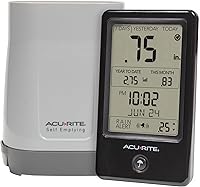
A manual gauge shows collected water directly, while a digital weather station reports rainfall electronically. A manual gauge needs you to read and empty it; a station can show rainfall history alongside other weather data.
The AcuRite Iris Weather Station with Rain Gauge reports rainfall history on its display, along with indoor and outdoor temperature and humidity, wind speed and direction, and barometric pressure. For an overview of its measurement method, see how a tipping bucket rain gauge works and what a self-emptying rain gauge is.
The AcuRite Iris sensor measures rain, temperature, humidity, wind speed, and wind direction. For other compatible options, compare rain sensors for weather stations.
It works with a compatible AcuRite 5-in-1 weather station display, sold separately.
For another display-based option, see digital rain gauges with temperature readings. If a station’s total seems low, learn why an Ambient Weather WS-2902 may underreport rain.
How should you record and compare rainfall?
Use the same gauge, units, location, and observation schedule when comparing rainfall. Consistent methods make your notes more useful than changing how you read the scale from one day to the next.
If readings seem off, follow the AcuRite rain gauge calibration steps.
Write down the amount before emptying the tube. If you need a running weekly or monthly total, add the recorded intervals and preserve the original readings in your log.
Treat missed readings and overflow as incomplete intervals. They can still tell you that rain fell, but they shouldn’t be compared as exact totals against complete observations.
How should you read a rain gauge and choose the right type?
Read the bottom of the meniscus at eye level, record the amount and time, then empty the tube for a fresh interval. Keep the gauge upright and return it to the same open location after each check.
Choose a manual gauge when a clear, direct reading is enough. Pick a digital station if you want rainfall history with other weather data, and use a replacement tube guide if the scale or tube is hard to read.
Frequently asked questions
How do you read a rain gauge accurately?
Read the water level at eye height and line up the bottom of the curved surface with the scale. Keep the gauge upright, check it at a consistent time, and record the amount before emptying it.
A clear observation time helps distinguish daily rainfall from a longer accumulation.
Do you read the top or bottom of the meniscus?
For a clear liquid in a tube, read the bottom of the meniscus, the curved surface where the water meets air. Bring your eyes level with that point to avoid reading from above or below.
If the tube or scale instructions specify another method, follow those instructions.
How often should you empty a manual rain gauge?
Empty a manual gauge after each reading if you want to measure rainfall over separate intervals, such as each day. Record the amount and observation time first.
If you leave water in the gauge, the next reading combines new rain with what was already collected.
What if rain rises above the scale?
If the water passes the top of the scale, the gauge may have collected more than it can show. Record that it overflowed, and don't guess at the unmeasured amount.
A larger-capacity tube may suit locations that often get heavy rain between observations.