Ambient Weather WS-5000 vs WS-4000: Which Should You Choose? (October 2026)
Choose the WS-4000 for its compact, tool-free installation, or the WS-5000 for its separate rain cup and specified pole mounting. Compare their sensor designs and installation needs before deciding.
On this page (5 sections)
Choose the WS-4000 for its compact, tool-free installation, or the WS-5000 for its separate rain cup and specified pole mounting. These are the clearest differences between the two Ambient Weather stations.
Both stations use ultrasonic wind sensing without moving parts, include a color console and connect with Ambient Weather Network. The WS-4000 combines its wind and haptic rain gauges in one compact array; the WS-5000 pairs its ultrasonic array with a separate rain cup.
 Best for specified pole mounting
Ambient Weather WS-5000 Ultrasonic Smart Weather Station
 Best for compact installation
Ambient Weather WS-4000 Solar Powered UltraSonic Wi-Fi
Ambient Weather WS-5000 vs WS-4000: what changes?
The WS-4000 combines wind and rain sensing in a compact array, while the WS-5000 has a separate rain cup. Both use ultrasonic wind sensing, so neither relies on moving wind cups.
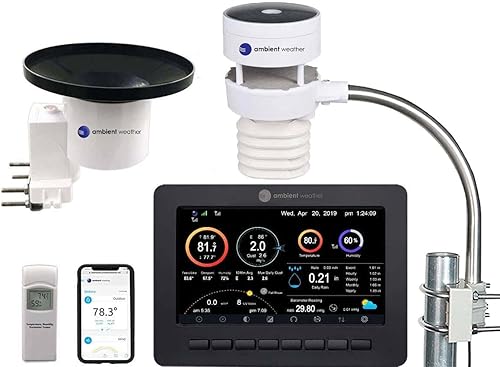
The WS-5000 includes an ultrasonic sensor array, rain cup, indoor/outdoor thermo-hygrometer-barometer and TFT full-color LCD display. Its separate rain cup has a removable lid for service and maintenance.
The WS-4000 has ultrasonic wind and haptic rain gauges in its all-in-one outdoor array. It also includes a color console and a WH32B sensor for indoor temperature, humidity and barometric pressure.
For the WS-5000's components and mounting details, see our Ambient Weather WS-5000 review. For the WS-4000's setup and sensor arrangement, read the Ambient Weather WS-4000 review.
Which station is easier to install?
The WS-4000 has a compact array and an installation described as requiring no tools. The WS-5000 has specified pole mounting hardware, a suitable pole requirement and a wireless connection between array and console.
The WS-5000 array mounts to a pole from 1.25 to 2 in in diameter with an adaptive bracket and U-bolts. The pole is not included, and the array connects to the console by 915 MHz radio frequency.
The WS-5000 can connect up to 1,000 feet line of sight in open air, with about 300 feet under most conditions. Its signal won't pass through solid metal, earth or ground, so consider obstacles between the array and console.
The WS-4000's compact all-in-one design is described as easy to install without tools. Check the manual for placement requirements before choosing an installation spot.
How should you choose a mounting location?
Choose a location that lets the sensors measure conditions without nearby obstructions, then check the manual for mounting guidance. For the WS-5000, use its bubble level during pole installation and allow for a clear radio path to the console.
The WS-5000 array includes a solar panel and a pagoda thermo-hygrometer radiation shield with passive aspiration. These features may matter if you have a fixed pole location and want to plan sensor orientation and access.
The WS-4000's compact array may suit a simpler mounting plan. Choose a spot where you can reach the sensor for routine checks.
How do the rain sensors differ?
Choose the WS-5000 for a separate rain cup, or the WS-4000 for a haptic rain gauge in its all-in-one array. The sensor designs can help you decide which station suits your yard.
The WS-5000 rain cup has a removable lid for service and maintenance access. Its separate design means the array and rain cup are distinct components to consider when planning placement.
The WS-4000 combines its haptic rain gauge with the ultrasonic wind sensor. This keeps the outdoor system compact and avoids moving parts in both sensing functions.
Consider access as well as sensor type. If you expect to inspect or service the rain gauge, consider how you can reach it after mounting.
What can you add to each station?
The WH31L lightning detector is compatible with the WS-5000, but its compatibility information doesn't name the WS-4000. If lightning data matters, confirm support for the exact station and firmware with Ambient Weather before buying an add-on.
The WH31L detects lightning within 25 miles and sends information every 79 seconds. It is not a standalone unit, and its compatibility list includes the WS-5000 and WS-2000 among other Ambient Weather systems.
The WH31L isn't rated for sustained direct rain contact. If you mount it outside, Ambient Weather recommends an enclosure such as the WH31-SRS Solar Radiation Shield.
For a comparison of two other console-based models, see our Ambient Weather WS-2000 vs WS-2902 guide. A separate Ambient Weather WS-2902 review can help if you're also considering that station.
Which station should you choose?
Choose the WS-4000 for a compact array and an installation described as tool-free, or the WS-5000 for a separate rain cup and specified pole mounting. Your mounting site and interest in lightning detection can settle the choice.
Pick the WS-4000 if its integrated sensor design fits your location and you want the simpler installation claim. Pick the WS-5000 if you can mount a suitable pole and value its separate rain cup, service access and specified radio connection range.
For another brand comparison, see Tempest vs Ambient Weather.
If lightning detection is a priority, the WH31L compatibility information names the WS-5000. Check with Ambient Weather before assuming it will work with the WS-4000.
Frequently asked questions
What is the main difference between the WS-5000 and WS-4000?
The WS-5000 pairs an ultrasonic sensor array with a separate rain cup and specified pole mounting hardware. The WS-4000 combines ultrasonic wind and haptic rain gauges in a compact all-in-one array described as requiring no tools for installation.
Does the WS-5000 require a mounting pole?
The WS-5000 array mounts to a pole between 1.25 and 2 inches in diameter using its adaptive bracket and U-bolts, and the pole is not included. Plan for a suitable mounting point before choosing it, and follow the manual's placement guidance.
Can you add the WH31L lightning detector to either station?
The WH31L compatibility information names the WS-5000 but not the WS-4000. If lightning detection matters, confirm compatibility with Ambient Weather before buying an add-on for the WS-4000.
Do both stations have no-moving-parts wind sensors?
Yes. Both use ultrasonic wind sensing, which avoids moving wind cups.
Their rain sensors differ: the WS-5000 has a separate rain cup, while the WS-4000 uses a haptic rain gauge.
Which console comes with the WS-4000 and WS-5000?
Both include a color LCD console. The WS-4000 console is described as the same premium color console used with the WS-2000 and WS-5000, while the WS-5000 includes a TFT full-color LCD display.