9 Best Weather Stations for Gardens (November 2026)
The best garden weather stations include the AcuRite Iris for everyday garden readings, the Newentor Weather Station Wireless Indoor Outdoor Thermometer for temperature and humidity checks, and the Ambient Weather WS-2902 Wi-Fi Smart Weather Station for remote garden monitoring.
On this page (7 sections)
- Which garden weather station fits your planting needs?
- How we chose garden weather stations
- What makes a weather station useful for a garden?
- How should you place a weather station near a garden?
- Should a garden weather station have Wi-Fi?
- When is a multi-sensor setup worth it?
- Which garden weather station should you choose?
The best garden weather station for most yards is the AcuRite Iris, which measures indoor and outdoor temperature and humidity, wind speed and direction, barometric pressure, and rainfall. That mix covers the conditions many gardeners check before watering, opening a cold frame, or deciding whether seedlings need protection.
Choose a Wi-Fi model for remote monitoring or a simpler display if you mainly want readings at home. A console by the door suits a quick morning check, while a phone view helps when you are away and want to know whether rain arrived while you were out.
Garden conditions can differ across a yard. A sunny border, a low spot and a sheltered greenhouse may each have a different mix of heat, moisture and airflow, so consider whether one outdoor sensor covers the area you care about.
That difference matters for everyday choices. A bed beside a fence may dry slower than an open bed, and a low corner can stay damp after rain while higher ground looks dry.
A single sensor gives you a useful reference, but it speaks for its own spot rather than every corner of the plot.
Think about how you actually garden before you narrow the choice. If you mainly track temperature and humidity near a potting bench, a focused monitor may be enough.
If watering, wind exposure and rainfall shape your routine, a fuller outdoor array earns its place.
Placement also shapes what the numbers mean. A sensor tucked under an eave may miss rain that reaches open beds, and one too close to a heated wall may read warmer than the plants nearby.
A short walk around the yard before mounting can save weeks of guessing later.
If you're weighing wider property needs, compare this guide with our picks for a best weather station for a farm or a best weather station for a greenhouse. To see what sensor types different stations include, read what sensors come with a home weather station.
Those related guides help when the garden is only part of the picture. A greenhouse needs indoor air readings, a farm may need wider coverage, and a home setup may focus on the console in a living space.
Matching the station to the place you will read it keeps the purchase practical and avoids paying for features you will rarely open.
Our picks at a glance
-
1

-
2
 Best for temperature and humidity checks
Newentor Weather Station Wireless Indoor Outdoor Thermometer
9.7/10 our score
See it on Amazon -
3
 Best for remote garden monitoring
Ambient Weather WS-2902 Wi-Fi Smart Weather Station
9.6/10 our score
See it on Amazon
- 4
 Best for lightning awarenessCheck it
- 5
 Best for straightforward local readingsCheck it
- 6
 Check it
VEVOR 7-in-1 Wi-Fi Weather Station with APP
Best for app-based sun and rain tracking - 7
 Check it
Sainlogic 12-in-1 Wireless Weather Station with Rain
Best for rainfall detail - 8
 Check it
Ambient Weather WS-2000 Smart Weather Station
Best for a detailed console view - 9
 Check it
WeatherFlow Tempest Weather Station with Built-in Wind
Best for a no-display setup
Which garden weather station fits your planting needs?
The AcuRite Iris is the highest-scoring option in this roundup, with a 9.7 score. These 9 stations range from a focused temperature monitor to connected stations with broader outdoor measurements.
The range is the point of the comparison. Some models answer a narrow question about heat and moisture, while others add rain, wind, sunlight or phone access, so the best fit depends on the decisions you make in the garden.
Read the summaries with your own routine in mind. A simple console may suit a small yard you check daily, while a connected array may suit a larger plot where you want readings from elsewhere on the property.
The details below sort those trade-offs in plain terms.
AcuRite Iris: Best for everyday garden readings
- Indoor and outdoor temperature and humidity
- Wind speed and direction
- Barometric pressure and rainfall
- Wi-Fi connection to Weather Underground
A broad set of local readings helps you check conditions around a home garden. Wi-Fi connection to Weather Underground adds remote monitoring and data sharing.
Pros
- Tracks rainfall and wind alongside temperature
- Weather Underground connection
- Historical data and threshold alerts
Cons
- The outdoor sensor needs a suitable mounting spot
- Wi-Fi features require a network connection
Newentor Weather Station Wireless Indoor Outdoor Thermometer: Best for temperature and humidity checks
- Indoor and outdoor temperature and humidity
- One remote sensor included
- Supports up to 3 remote sensors
- Color LCD with adjustable backlight
This is a simple fit if plant care decisions mostly depend on temperature and humidity at one or more locations. It does not measure rainfall or wind.
Pros
- Can monitor multiple locations with added sensors
- Daily high and low records and alerts
- Display offers adjustable brightness
Cons
- Only one remote sensor is included
- No rainfall or wind readings
Ambient Weather WS-2902 Wi-Fi Smart Weather Station: Best for remote garden monitoring
- Wind speed and direction
- Temperature, humidity and rainfall
- UV intensity and solar radiation
- Wi-Fi remote monitoring and alerts
The sensor array tracks several conditions that matter when you are away from the garden. Wi-Fi features support remote access and alerts.
Pros
- Includes rainfall, UV and solar radiation
- Remote access and alerts
- Supports weather network sharing
Cons
- The sensor array needs a pole or other suitable mount
- Wi-Fi setup adds a network dependency
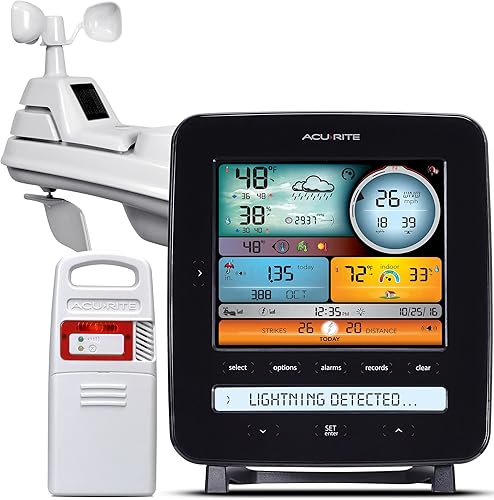
AcuRite Iris: Best for lightning awareness
- Indoor and outdoor temperature and humidity
- Wind speed and direction, pressure and rainfall
- Estimated distance to lightning-producing storms
- Historical weather records
Along with garden weather readings, this station estimates distance to lightning-producing storms and tracks strike counts. Its added storm information can help you decide when to pause outdoor work.
Pros
- Tracks a broad range of weather readings
- Lightning estimates and strike records
- Auto-dimming display and alerts
Cons
- Lightning detection is an estimate
- No Wi-Fi connection is specified for this model
AcuRite Iris: Best for straightforward local readings
- Indoor and outdoor temperature and humidity
- Wind speed and direction, pressure and rainfall
- Color LCD with adjustable dimmer
- Personalized forecast based on local readings
This AcuRite model combines core yard readings with a color display and a personalized forecast. It suits gardeners who want a dedicated console for local conditions.
Pros
- Rainfall and wind readings
- Historical weather information
- Garden is a recommended use
Cons
- No remote monitoring feature is specified
- Outdoor sensor needs a mounting location
VEVOR 7-in-1 Wi-Fi Weather Station with APP: Best for app-based sun and rain tracking
- Temperature, humidity, rainfall and wind
- Sunlight and dew point
- Smart Life app support
- Solar-powered outdoor sensor
Sunlight and rainfall readings add useful context for garden care, and the Smart Life app supports remote viewing and data storage. The display adapter must stay plugged in for Wi-Fi sync.
Pros
- Tracks sunlight and rainfall
- App supports viewing and sharing data
- Solar panel and battery backup
Cons
- Wi-Fi supports 2.4 GHz only
- App syncing needs the display adapter plugged in
Sainlogic 12-in-1 Wireless Weather Station with Rain: Best for rainfall detail
- Rainfall with manual calibration
- Temperature and humidity
- Wind, pressure and dew point
- Large screen with adjustable backlight
Rainfall tracking and manual calibration make this a candidate for gardeners who want to compare local precipitation over time. Its screen also shows wind and other core readings.
Pros
- Rainfall measurements with manual calibration
- Tracks wind and dew point
- Adjustable display backlight
Cons
- No Wi-Fi is specified
- Temperature accuracy is stated as plus or minus 2°F
Ambient Weather WS-2000 Smart Weather Station: Best for a detailed console view
- Wind speed and direction
- Temperature, humidity and rainfall
- UV and solar radiation
- Color TFT display
The console combines readings from the sensor array with calculated details such as dew point and feels-like temperature. Wi-Fi publishing is available as an option.
Pros
- Measures rainfall, UV and solar radiation
- Console includes high and low alerts
- Supports imperial and metric units
Cons
- Optional indoor sensor is sold separately
- Wi-Fi publishing is described as optional
WeatherFlow Tempest Weather Station with Built-in Wind: Best for a no-display setup
- Temperature, humidity and pressure
- Wind, rainfall, UV and solar radiation
- Lightning strike readings
- Solar-powered outdoor sensor
Tempest brings many outdoor readings into one sensor and works with supported smart home platforms. It has no display, so plan to check conditions through a connected service.
Pros
- Measures a wide range of garden conditions
- Solar-powered sensor
- Supports Alexa and other integrations
Cons
- No display is included
- Requires a connected device or service to view readings
How we chose garden weather stations
We compared the measurements, display or app access, sensor support and connection options against common garden tasks. A station that measures rainfall and wind serves a different need from a thermometer that tracks temperature and humidity.
That distinction runs through every score in this roundup. A gardening task such as deciding whether to water turns on rainfall and soil observation, while a task such as protecting tender plants turns more on overnight temperature and humidity.
Neither need is better in the abstract, and each points to a different kind of station.
Our score weighs specs and features against what you're shopping for. A forecast is not a substitute for measured conditions at your planting location, and a single sensor reports conditions at its own location.
We also looked at how readings reach you. A large console display suits a work area or kitchen where you pass several times a day.
App access suits a gardener who wants to check conditions from another room or away from home, but it adds a network step that a plain wireless display does not need.
Practicality mattered in the comparison as well. Mounting needs, sensor placement and upkeep all shape whether a station stays useful after the first month.
A model with many readings is only helpful if its outdoor unit sits in a spot that truly reflects your beds and if you can reach it for cleaning and checks.
For gardeners who want multiple reading points, best home weather stations with multiple sensors explains how additional sensors can help compare indoor and outdoor areas. If your setup needs formal data sharing, see our guide to best CWOP weather stations.
Those two guides cover different goals. Extra sensors help you compare a shaded bench with an open border, while formal sharing suits a station that feeds an outside network.
Neither goal changes the core test here, which is whether the readings match the garden decisions you make each week.
We kept the language tied to the listed features rather than general promises. Where a model lacks rain or wind readings, we said so, and where Wi-Fi is optional or limited, we noted that too.
That approach helps you see the actual trade-off instead of buying a feature list meant for a different yard.
What makes a weather station useful for a garden?
A garden weather station is useful when its readings answer a real care question. Rainfall can help you judge whether a bed received water, while temperature, humidity and wind give context for the conditions around plants.
Which readings matter most in a garden weather station?
Rainfall, temperature, humidity and wind are core readings for many home gardens. A station that adds sunlight or UV can help you compare exposed areas, but those readings do not replace observing how much shade a bed gets during the day.
Each reading answers a different care question. Temperature helps you judge frost risk and heat stress, humidity hints at how damp leaves and soil may stay, rainfall shows whether a bed caught water, and wind explains drying, damage or uneven exposure across a plot.
Shade deserves a plain note because it is easy to overread a sun sensor. A reading taken at the sensor will not describe a bed under a tree or beside a shed, so use sunlight data to compare open spots and use your own observations for sheltered ones.
AcuRite Iris and Ambient WS-2902 include rainfall and wind alongside temperature and humidity. The VEVOR model adds sunlight readings and app access, while the Newentor focuses on temperature and humidity at sensor locations.
That split shows the main choice in this guide. A broader array suits gardeners who track watering and wind exposure, while a focused temperature and humidity station suits gardeners whose main question is whether the air is too hot, too cold or too damp for seedlings and tools.
Barometric pressure and dew point add context rather than a direct garden task. Pressure trends can sit alongside a forecast, and dew point helps explain morning dampness, yet neither replaces a rain gauge at soil level.
Treat them as supporting detail and keep the focus on readings you will act on.
For watering, the most honest use of rainfall data is modest. It can confirm that rain reached the gauge, and it can prompt a check of soil moisture before you skip a watering.
It cannot tell you how much water a raised bed or container actually kept.
Can garden weather stations help with watering?
Rainfall readings can help you decide whether recent precipitation changes your watering plan. They measure conditions where the station sits, so compare the gauge location with the beds you water.
A gauge under an eave or beside a tall structure may not reflect rainfall reaching an open planting bed. Keep the sensor clear and use observations at the plants as a second check.
Does a garden need wind readings?
Wind readings are useful when your garden has exposed plants, trellises, containers or other features affected by gusts. They can also help you understand why conditions at one location differ from a sheltered corner.
If wind is a priority, choose a station with speed and direction readings, such as the AcuRite Iris, Ambient WS-2902 or Tempest. For more on wind sensors, read our wind sensor guide.
How should you place a weather station near a garden?
Place the sensor where it can sample open air and rainfall representative of the area you want to monitor. Follow the station's mounting instructions and avoid spots where walls, roofs or nearby surfaces could affect the readings.
Start with the beds you care about most. If one border matters more than the lawn, choose a spot that shares its sun, wind and exposure rather than a convenient post by the door.
The sensor is a stand-in for that planting, so similarity matters more than central convenience.
Before mounting, choose a location with access for maintenance and a clear wireless path to the console when the model uses one. A single sensor reports conditions at its own location, so a large yard or mixed landscape may call for multiple measurement points.
Access is a practical detail that is easy to skip at setup. You will want to check the rain gauge, clear leaves, confirm the mount is still level and look for damage after storms.
A spot you can reach with a short step stool will get that care more often than a high roof edge.
Height and clearance also affect wind and rain readings. A sensor boxed in by fences or shrubs may underreport gusts, while a gauge under a drip edge may miss rain that falls on open soil.
Give the unit room to breathe, and keep it away from sprinklers that could splash the gauge or wet the temperature sensor.
Some stations mount to a pole, and the pole's height and stability affect where the sensor sits. See our guide to the best ground mounting poles for weather stations when planning a separate mount.
A firm, level pole matters as much as the sensor itself. Wobble can tilt a rain gauge and make wind direction less steady, while a pole that leans after winter will slowly change the readings.
Check the mount after strong wind and again when leaves come out in spring.
A greenhouse can need a different setup from an open garden because enclosed air and outdoor exposure are different measurement questions. Our best weather station for a greenhouse guide focuses on that use.
For an open garden, do not expect one outdoor unit to describe the air inside a shed or cold frame. Use the outdoor sensor for the yard, and treat enclosed spaces as a separate check when seedlings or tools need a closer look.
Should a garden weather station have Wi-Fi?
Wi-Fi is useful if you want to check readings away from the console or share data online. A basic wireless station can still suit you if you mainly check a display at home.
The choice comes down to where you read the weather. A bedroom or kitchen console gives a quick answer during your morning routine, while phone access helps when you are at work and want to know whether rain passed over the garden during the day.
AcuRite Iris with Wi-Fi and Ambient WS-2902 support connected monitoring. VEVOR pairs with the Smart Life app, while the WS-2000 supports optional weather publishing; match the connection details to your home network and routine.
Those details are not minor. Some setups depend on a 2.4 GHz network, some keep the display adapter plugged in for syncing, and some treat online publishing as an option rather than a default.
Check the listed connection before you plan to rely on remote checks, and set your expectations by the model you choose.
Connected monitoring also changes upkeep. You may need to confirm the network still connects after a router change, check the app after a phone update, and decide how often you will look at the data.
A gardener who rarely opens an app may get more value from a bright console that answers at a glance.
Wi-Fi can suit sharing as well as convenience. A station that sends data to a network lets others see local conditions, which can help a household or a small growing group compare notes.
That sharing is a separate goal from garden care, so weigh it only if you actually plan to use it.
A connected station does not make a forecast certain. Read can a home weather station predict weather to learn what local measurements and forecasts can tell you.
Use remote readings as a prompt to look closer, not as a final word on the garden. Rain on the gauge still calls for a soil check, and a warm afternoon reading still calls for a walk past the beds.
The station informs the visit, and the visit confirms what matters for the plants.
When is a multi-sensor setup worth it?
Multiple sensors are worth considering when you want to compare conditions in separate parts of a property. A shaded bed, potting area and greenhouse may not share the same temperature or humidity.
Comparison is the real benefit of more than one sensor. One unit near an open border and another near a sheltered bench can show morning dampness in one spot and early drying in the other, which a single reading would smooth away.
Newentor supports up to 3 remote sensors and includes one. Some stations provide a broad outdoor array instead, so decide whether you need more locations or more types of weather readings before choosing.
That choice shapes cost and care as well. Extra sensors mean extra batteries, extra spots to mount and extra readings to interpret, while a broad array means one outdoor unit with more kinds of data.
Neither approach is automatically better for a garden.
Think about the questions you ask each week. If you want to know whether the greenhouse runs warmer than the yard, locations matter most.
If you want to track rain and gusts in one open plot, types of readings matter more than a second thermometer.
Placement discipline grows with each added sensor. Labels in your own notes, matching heights where possible and similar exposure for fair comparisons all help.
A sensor on a sunny wall and another in deep shade will differ for obvious reasons, and the gap may tell you more about the mount than the garden.
If gardening is part of a larger property operation, our guide to weather station for commercial use covers broader monitoring needs. For wider agricultural land, the best weather stations for farms page may fit better.
Those larger setups suit different scales of land and record keeping. A home garden usually needs a small number of well placed sensors and a routine you will keep.
Add coverage only when a specific bed, structure or field keeps raising a question that one sensor cannot answer.
Which garden weather station should you choose?
Choose AcuRite Iris if you want temperature, humidity, wind, pressure and rainfall readings in one station. Pick Newentor for temperature and humidity across sensor locations, or Ambient WS-2902 if remote monitoring and UV and solar readings matter more.
VEVOR adds app access and sunlight measurements, while Sainlogic tracks rainfall with manual calibration. Match the station to the readings you use, then place its sensor where those measurements represent the garden you care for.
A short final check can keep the choice honest. List the three readings you will check most often, confirm the model measures them, and confirm you can mount the sensor in a spot that reflects your beds.
If the model also offers a feature you will never use, that is fine, but do not let an unused feature outweigh a missing core reading.
Also confirm how you will read the data day to day. A console suits a home routine, app access suits remote checks, and a no-display setup suits a household that already uses a connected service.
The right choice is the one that fits your path through the house and yard.
Once you choose, give the setup a few weeks of ordinary use before judging it. Note where the sensor sits, check the gauge after rain and look at the beds themselves.
That small habit turns a list of readings into a useful garden habit, and it shows whether the station earns its place.
Our top 3 picks at a glance
-
1
-
2
Best for temperature and humidity checks
Newentor Weather Station Wireless Indoor Outdoor Thermometer
9.7/10 our score
See it on Amazon -
3
Best for remote garden monitoring
Ambient Weather WS-2902 Wi-Fi Smart Weather Station
9.6/10 our score
See it on Amazon
Frequently asked questions
What should a garden weather station measure?
A useful garden weather station measures outdoor temperature, rainfall, wind and humidity. Those readings help you compare conditions across the yard and plan watering or outdoor work.
UV or sunlight readings can add context for exposed beds.
Choose based on the conditions you actually use to make care decisions.
Is a temperature-only station enough for a garden?
A temperature and humidity station can be enough if those are the readings you check most often. The Newentor monitors both indoors and outdoors and supports up to 3 remote sensors.
Choose a station with a rain gauge if local rainfall changes your watering plans, or wind readings if your plantings are exposed.
Where should I place an outdoor weather sensor?
Place the sensor where it can measure the conditions you want to understand, with room around it and without nearby obstacles affecting the reading. Follow the model's mounting guidance and keep the rain gauge clear.
A station near a wall, roof edge or paved surface may reflect that spot rather than the wider garden.
Can a home weather station predict garden weather?
A home station can show current local conditions and, depending on the model, calculate a short-term forecast. It cannot guarantee what will happen across every part of a garden.
Use its readings as one input alongside the forecast for your area.
Our guide explains whether a home weather station can predict weather.