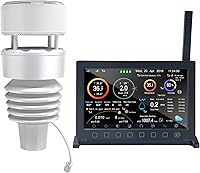
9 Best Indoor Weather Stations for Home (November 2026)
The best Indoor Weather Stations for Home include the Newentor Weather Station Wireless Indoor Outdoor Thermometer for busy family rooms, the Newentor Weather Station Wireless Indoor Outdoor for across-room viewing, and the La Crosse Technology 308-1417 Wireless Barometric Pressure Weather for pressure watchers.
On this page (6 sections)
The best indoor weather stations for home put room temperature and humidity where you can check them quickly. Newentor's Q3 is the strongest all-around choice for a color screen, forecast, clock, alerts, and room to add sensors.
A central display plus one remote location covers the usual questions about comfort and conditions outside. Most households do not need every reading every time.
Start with daily use. A bedroom display needs a readable screen and sensible brightness.
A basement or garage monitor may need battery power and a remote sensor.
Think about where you will glance at it most. A kitchen screen gets frequent short checks.
A nursery screen needs to be clear without distracting at night.
Forecast icons, pressure history, wind, and rainfall help only if you plan to use them. If indoor comfort is your main goal, temperature and humidity visibility should come first.
Sensor placement shapes the right choice. A sensor near a sunny window tells you about that window, not the whole room.
Power is another daily detail. An always-on display suits a spot near an outlet.
A battery display gives more placement freedom but may light only briefly when pressed.
Alerts help when you care about a limit, such as a cold storage room or a warm nursery. Clock and date add value when the display doubles as a bedside clock.
Our picks at a glance
-
1
 Best for busy family rooms
Newentor Weather Station Wireless Indoor Outdoor Thermometer
9.7/10 our score
See it on Amazon -
2
 Best for across-room viewing
Newentor Weather Station Wireless Indoor Outdoor
9.6/10 our score
See it on Amazon -
3
 Best for pressure watchers
La Crosse Technology 308-1417 Wireless Barometric Pressure Weather
9.6/10 our score
See it on Amazon
- 4
 Check it
La Crosse Technology Advanced Weather Station
Best for color forecast icons - 5
 Check it
LICHI Indoor Outdoor Thermometer Wireless Weather Station
Best for compact spaces - 6
 Best for backyard trackingCheck it
- 7
 Check it
AcuRite Wireless Home Weather Station with Color
Best for everyday room checks - 8
 Check it
FOKEY Weather Station Wireless Indoor Outdoor
Best for sensor-side readings - 9
 Check it
DreamSky Weather Station Indoor Outdoor Thermometer Wireless
Best for outlet-free placement
How we chose indoor weather stations for home
We compared these stations by how well readings, displays, sensor options, and power choices fit common home setups. The picks cover simple room checks, multiple locations, forecast details, and broader backyard monitoring.
Our focus stayed on practical use rather than long feature lists. A station earns its place when you can read it at a glance and understand what each number refers to.
Wireless usually describes the connection between a remote sensor and its display. It does not necessarily mean Wi-Fi, an app, or online weather access.
That distinction affects placement and expectations. A radio link sends sensor readings to the display, but many models do not send data to a phone or website.
We also separated sensor support from sensor count. Support for multiple channels means you can add sensors later, while the box may include only one.
Display behavior on battery power received close attention. Some screens dim or light briefly to save energy, while adapter-powered models can stay lit.
Power needs shape where a station can sit. A battery model fits a remote shelf, and an adapter model fits a counter near an outlet.
Readings beyond temperature and humidity were weighed by usefulness. Pressure trends and forecast icons help for planning, while wind and rainfall suit wider outdoor monitoring.
Ease of setup matters in daily life. A station should connect without complicated steps, and sensors need a clear spot away from direct sun and heat.
Compare the best indoor weather stations for home
The key differences are screen visibility, power, sensor capacity, and how much information appears beyond temperature and humidity. Use the table to narrow your options, then match a model to where it will sit and what you will check most often.
Start with placement. A display across a room needs wide viewing angles or a large screen.
A bedside display needs brightness you can lower at night.
Next, check power. An adapter supports a continuously lit screen, while battery operation may limit lighting to brief checks.
Then consider sensors. One remote sensor compares two locations.
Support for additional channels lets you expand to a nursery, basement, garage, or outdoor spot later.
Finally, look beyond the core readings. Forecast, pressure history, wind, and rainfall add context for some households and add clutter for others.
Keep the comparison practical. The best fit is the station whose screen, power, and sensor plan match the rooms you use each day.
| Product | Best for | Display | Sensors | Power | Our score |
|---|---|---|---|---|---|
| Newentor Weather Station Wireless Indoor Outdoor Thermometer | busy family rooms | Color LCD with adjustable brightness | 1 included; supports up to 3 | Adapter for always-on display; battery eco mode | 9.7 |
| Newentor Weather Station Wireless Indoor Outdoor | across-room viewing | LCD with 3 brightness levels on adapter power | 1 included; supports 3 channels | Adapter with battery backup for memory | 9.6 |
| La Crosse Technology 308-1417 Wireless Barometric Pressure Weather | pressure watchers | LCD | Battery operated; batteries not included | 9.6 | |
| La Crosse Technology Advanced Weather Station | color forecast icons | Full-color LCD | Adapter for full display; optional battery backup | 9.3 | |
| LICHI Indoor Outdoor Thermometer Wireless Weather Station | compact spaces | 4-inch LCD with 10-second backlight | 1 included; supports up to 3 | 3 AAA batteries for display; 2 AA for sensor | 9.2 |
| AcuRite Iris | backyard tracking | Color LCD with adjustable dimmer | Corded electric; 10 AA batteries required | 9.0 | |
| AcuRite Wireless Home Weather Station with Color | everyday room checks | Color LCD with adjustable dimmer | AC adapter with optional battery backup | 8.7 | |
| FOKEY Weather Station Wireless Indoor Outdoor | sensor-side readings | 7.6-inch VA display | Supports up to 3 remote sensors | 8.6 | |
| DreamSky Weather Station Indoor Outdoor Thermometer Wireless | outlet-free placement | 7.2-inch LCD | 1 included; supports 3 channels | 3 AAA batteries for display; 2 AA for sensor | 8.3 |
The best indoor weather stations for home
The right indoor weather station depends on how many places you want to monitor and how you will use the display. These picks range from a feature-rich central screen to compact or battery-powered options.
Newentor Weather Station Wireless Indoor Outdoor Thermometer: Best for busy family rooms
- Color LCD with adjustable brightness
- Indoor and outdoor temperature and humidity
- Supports up to 3 remote sensors
- Forecast, pressure, clock and alerts
A color screen combines indoor and outdoor readings with forecast, pressure, clock and alert features. It supports up to 3 remote sensors for monitoring more than one location.
Pros
- Adjustable brightness
- Can monitor multiple locations
- Adapter supports an always-on screen
Cons
- Only 1 remote sensor is included
- Battery-only display dims after a quick glance
Newentor’s Q3 puts indoor and outdoor temperature and humidity on a color LCD with daily highs and lows, time, date, forecast, moon phase, and barometric pressure. Customizable alerts let you set limits for readings you want to watch.
The display stays on when connected to its included adapter, and its brightness is adjustable. On batteries alone, it shifts into an energy-saving mode and lights up briefly for a quick check.
One remote sensor is included, and the station supports up to 3 sensors. That makes it practical to start with one remote location and expand monitoring later.
Choose it for a main living area where a bright, always-on screen and several kinds of readings are useful. Skip it if you need a display that stays illuminated while running on batteries alone.
For more options centered on forecasts, see our best weather stations with forecast displays.
Newentor Weather Station Wireless Indoor Outdoor: Best for across-room viewing
- Wide viewing angles
- Indoor and outdoor temperature and humidity
- Supports 3 remote channels
- Adjustable brightness when plugged in
The wide viewing angles suit a display placed across a room. Three remote channels let you add readings for other rooms or locations.
Pros
- Designed for broad viewing angles
- Three sensor channels
- Brightness can be set high, low or off
Cons
- Only 1 sensor is included
- Battery operation limits screen lighting
This Newentor model suits a display placed across a room, thanks to its wide viewing angles. It shows indoor and remote temperature and humidity, along with time, date, forecast, and barometric pressure.
Wide angles help when the screen sits on a shelf or kitchen counter and you view it from the side. That design suits shared spaces where people stand in different spots.
Three remote channels let you add readings from other rooms, though only one sensor is included. You can start with one remote spot and add more only if your plan expands.
When plugged in, the screen offers high, low, and off brightness settings. Battery power provides memory backup and only brief backlighting, so the adapter is better for a main living area.
Choose it if you want to glance at the screen from different spots or plan to monitor multiple rooms. Skip it if a color display or long-lasting backlight on battery power is a priority.
For setup, keep the sensor away from direct sun and heat and check readings after you move it to its permanent spot.
If space is your main constraint, compare it with our best small weather stations for home.
La Crosse Technology 308-1417 Wireless Barometric Pressure Weather: Best for pressure watchers
- 24-hour barometric pressure graph
- Dynamic forecast with tendency indicators
- Indoor and outdoor temperature and humidity
- Temperature alerts and MIN/MAX records
A pressure history graph and forecast tendency indicators add context to indoor and remote sensor readings. It runs on batteries, so the display can be placed without a nearby outlet.
Pros
- Shows a 24-hour pressure history
- Records high and low readings
- Battery-powered display
Cons
- Batteries are not included
- No color display
La Crosse’s 308-1417 is the pick for people who want a clear record of pressure changes over 24 hours. Its LCD pairs the pressure graph with a changing forecast and tendency indicators.
For more home options with pressure readings, see digital barometers for home.
It also measures indoor and outdoor temperature and humidity, keeps MIN/MAX records, and supports temperature alerts. Its wireless sensor has a stated range of up to 330 ft without obstructions; walls and other obstacles can reduce reception.
Both the display and sensor run on batteries, which suits a shelf without a nearby outlet. Batteries are not included, so have the required cells ready for setup.
Choose this model if pressure history and flexible placement matter more than color graphics. Skip it if you want an adapter-powered, continuously lit screen.
For a plain-language look at forecast limits, read what a home weather station can predict.
La Crosse Technology Advanced Weather Station: Best for color forecast icons
- Color forecast icons
- Indoor and outdoor temperature and humidity
- Adjustable backlight
- MIN/MAX records and customizable alerts
Color forecast icons, indoor and outdoor readings, alerts and an adjustable backlight make this a useful central display. It can run on an adapter, with optional battery backup.
Pros
- Full-color forecast icons
- Adjustable backlight
- Includes an alarm with snooze
Cons
- Battery-only backlight is temporary
- Backup batteries are not included
La Crosse’s Advanced Weather Station combines color forecast icons with indoor and outdoor temperature and humidity. It records MIN/MAX readings and lets you set alerts for temperature changes.
Color icons make the forecast easier to scan in a shared space. You can see the general outlook quickly, while the readings give the room details.
The adjustable backlight has high, low, and off settings. The included 5V adapter powers the full display, optional backup takes 3 AAA batteries, and battery-only use lights the screen temporarily.
That power setup suits a kitchen or living room near an outlet. Set brightness for daytime, then lower it or turn it off at night.
An alarm with a 10-minute snooze adds clock functions. MIN/MAX records help show how conditions changed during the day, even when the current reading looks normal.
Alerts are useful when a limit matters, such as a warm room or cold storage area. Set them around the sensor location, since a reading only reflects that spot.
Skip it if the display must stay lit without an adapter. For a simpler option, see our best simple home weather stations.
LICHI Indoor Outdoor Thermometer Wireless Weather Station: Best for compact spaces
- 4-inch LCD
- Indoor and outdoor temperature and humidity
- Supports up to 3 sensors
- Foldable stand and hanging ring
The compact display can stand on a surface or hang on a wall, and it runs on batteries. It supports up to 3 sensors for monitoring additional locations.
Pros
- Foldable stand and hanging ring
- Supports multiple sensors
- Backlight button for brief viewing
Cons
- Batteries are not included
- Backlight lasts 10 seconds
LICHI's 4-inch LCD keeps the display footprint compact while showing indoor and outdoor temperature and humidity. A foldable stand and hanging ring let you place it on a table or hang it on a wall.
The small screen fits a desk, nightstand, shelf, or small bedroom corner. It suits quick checks where a larger display would crowd the surface.
The station supports up to 3 sensors, with one included. That lets you compare the display room with another room or an outdoor spot, and expand only if you need more locations.
Its backlight stays on for 10 seconds after you press the button. It works best for quick checks rather than a constantly visible screen, not a clock you read from across the room.
The display and sensor run on replaceable batteries, which makes placement independent of an outlet. Keep spare cells on hand and replace them when readings stop updating.
Skip it if you need a large screen or a backlight that remains on. The trade-off is screen size and lighting for a smaller footprint and flexible placement.
For more screen space, compare the best large-display weather stations.
AcuRite Iris: Best for backyard tracking
- Indoor and outdoor temperature and humidity
- Wind speed and direction, pressure and rainfall
- Color LCD with adjustable dimmer
- Forecast based on pressure and elevation data
Iris adds wind and rainfall measurements to indoor and outdoor temperature and humidity. Choose it if you want a broader backyard weather picture alongside a home display.
Pros
- Includes wind and rainfall readings
- Tracks over 55 data points
- Shows pressure trends
Cons
- More features than needed for room-only monitoring
- Requires 10 AA batteries
AcuRite Iris adds wind speed and direction, barometric pressure, and rainfall to indoor and outdoor temperature and humidity. Its color LCD shows time and date with an adjustable dimmer, and the station tracks more than 55 data points.
That broader set suits a household that wants backyard conditions alongside room readings. Wind and rainfall help with garden decisions and outdoor plans.
The display combines elevation data from the outdoor sensor with barometric pressure to create a personalized forecast. AcuRite describes it as a forecast for about 12 hours from current conditions.
Treat that forecast as a local estimate based on your sensor and pressure readings. It adds context, but it does not replace an official forecast for severe weather.
Choose Iris if you want room readings as part of a wider backyard setup. Skip it if you only need indoor temperature and humidity.
Setup needs more thought than a basic indoor monitor. The outdoor sensor needs a clear mounting spot, and the indoor display should sit where you can read the dimmer settings easily.
Keep the outdoor sensor clean and check its position after storms. A moved sensor can change wind or rainfall readings.
To understand the sensor mix before choosing, read what sensors come with a home weather station.
AcuRite Wireless Home Weather Station with Color: Best for everyday room checks
- Indoor and outdoor temperature and humidity
- Barometric pressure trends
- Color LCD with adjustable dimmer
- Moon phase and daily highs and lows
This AcuRite display pairs indoor readings with a remote sensor for outdoor conditions. It adds pressure trends, moon phase and daily high and low records.
Pros
- Adjustable dimmer
- Displays daily highs and lows
- AC adapter included
Cons
- Optional backup batteries are not included
- No additional sensor channels are specified
This AcuRite station focuses on temperature, humidity, and pressure trends for indoor and outdoor conditions. Its color LCD has an adjustable dimmer, daily high and low records, trend arrows, and moon phase.
The color screen makes daily records easier to scan. Highs and lows show how the room or outdoor spot changed, while trend arrows give a quick sense of direction.
The display uses an included AC adapter, with room for 3 AA batteries as optional backup. The outdoor sensor takes 2 AA batteries, which are not included.
Adapter power suits a central spot in a living room, office, or bedroom. Battery backup helps preserve settings if power is interrupted, but it is not the main display power.
Its forecast uses outdoor sensor data for a personalized view of conditions around your home. Pressure trends show whether conditions are rising or falling.
Choose it for a color home display with daily records and a clock. Skip it if you want to add multiple remote sensors, since additional channels are not specified.
For placement, keep the display where the dimmer suits the room and avoid direct sun and heat for both readings.
For a screen easier to view from farther away, see our best weather stations for elderly users.
FOKEY Weather Station Wireless Indoor Outdoor: Best for sensor-side readings
- 7.6-inch VA display
- Supports up to 3 remote sensors
- Remote sensor has its own digital screen
- Atomic clock function
The large display is designed to be read across a living room or kitchen. The remote sensor also has a screen, and the system supports up to 3 sensors.
Pros
- Large display
- Remote sensor includes a screen
- Supports multiple sensors
Cons
- Number of sensors included is not specified
- Power details are not specified
FOKEY’s 7.6-inch VA display is designed for viewing across a living room or kitchen. Its remote sensor has a digital screen of its own, so readings can be checked at the sensor location as well as on the main display.
The system supports up to 3 remote sensors and lists a wireless range of up to 328 ft. The number of sensors included is not specified, so check package contents before planning around multiple locations.
It also has an atomic clock function. Choose it when screen size and a sensor-side readout are useful, such as in a garage or workshop.
Skip it if you need confirmed power details before deciding where to place the display. The guide to wall-mount weather stations can help if you are planning a fixed wall location, and our decorative weather stations for the wall covers another approach to display placement.
DreamSky Weather Station Indoor Outdoor Thermometer Wireless: Best for outlet-free placement
- 7.2-inch LCD
- Indoor and outdoor temperature and humidity
- Pressure trends and forecast
- High and low alerts
The large LCD displays room and remote sensor readings, pressure trends, forecasts and alerts. Battery power allows placement away from an outlet.
Pros
- Large display
- Supports up to 3 sensor channels
- Selectable flash and beep or flash and mute alerts
Cons
- Batteries are not included
- Only 1 sensor is included
DreamSky's 7.2-inch LCD shows indoor and outdoor temperature and humidity, pressure trends, a forecast, and daily MIN/MAX records. Customizable high and low alerts can flash and beep or flash silently.
The large screen suits a living room, kitchen, or bedroom where you want to read conditions from a short distance. MIN/MAX records show the range for the day.
The display and remote sensor both run on batteries, so the screen can sit away from an outlet. The station supports 3 channels, with one outdoor sensor included.
Keep spare batteries available, since both the display and sensor need power to keep updating. It also works as an atomic clock with date, day of the week, and automatic daylight saving time.
Alert style matters in shared or sleeping spaces. Flash and beep draws attention, while flash and mute keeps the alert visual when sound would be disruptive.
Choose DreamSky for a large battery-powered display with alerts and forecast information. Skip it if you prefer an adapter-powered screen or do not want to keep batteries on hand.
For another clock-focused option, browse large-display weather station clocks and mains-powered weather stations.
What should you check before choosing an indoor weather station?
Choose by the readings you need, the places you want to monitor, and where the display will sit. A long feature list is less useful than readings you can see and understand in the rooms that matter.
Which readings and sensors do you need?
Temperature and humidity are the core readings for indoor comfort checks. A remote sensor helps you compare the display room with a bedroom, basement, garage, or outdoor spot.
Sensor capacity and included sensor count are different. Several models support multiple channels but include only one sensor, so consider the starting setup and whether you intend to add sensors later.
Will the display stay lit where you want it?
A continuously lit screen is handy in a kitchen or living area where you pass it often. Some models need an adapter for an always-on display, while battery-only modes may dim the screen or light it briefly when you press a button.
Check the power arrangement before choosing a location. An adapter-powered model suits a spot near an outlet, while a battery-powered display is easier to place on a remote shelf but may need a button press for viewing.
Brightness control matters as much as the power source. A screen that is easy to read in daylight may be too bright at night without a low or off setting.
Consider how often you will check the display. Frequent short glances favor an always-on screen, while occasional checks can work with a brief backlight.
Plan for battery replacement if you choose battery power. Keep the right cells on hand and check that readings resume after a change.
Match the power choice to the room. A central kitchen display usually benefits from adapter power, and a far shelf or nursery may benefit from battery placement.
Do you need a forecast or just room conditions?
Forecast displays can add a short-range local estimate based on pressure and sensor readings. They are useful as context, but they do not replace an official forecast.
If your goal is to manage indoor comfort, prioritize temperature and humidity visibility first. Choose pressure history or forecast features when you will actually check trends and use them in daily planning.
Where should the remote sensor go?
Place each sensor where its reading represents the area you care about, away from direct sun, heating vents, and other strong heat sources. Check the stated wireless range, and remember that walls and other obstructions can weaken reception.
Start with the sensor near the display during setup, then move it to the intended room or outdoor location. Confirm that readings continue to appear after the move before settling on a permanent spot.
How do you set up and care for a home weather station?
Read the power and sensor instructions before inserting batteries or connecting the adapter. Keep the display and remote sensor away from water, excessive heat, and places where furniture or metal objects may block the signal.
Give sensors space around their vents and keep them clean and dry. Replace batteries when low-power indicators appear or readings stop updating, and check the wireless connection after moving either unit.
What mistakes can make readings less useful?
The most common mistake is treating a sensor reading as representative of a whole home when it sits in direct sun, a draft, or nearby heat. Placement matters as much as the number shown on the screen.
A sensor by a sunny window will run warm in the afternoon. A sensor near a heating vent will reflect that vent more than the room where people sit.
Also avoid assuming wireless means internet-connected, or that support for 3 channels means 3 sensors come in the box. Check power needs, sensor count, and screen behavior before purchase.
Wireless usually means a radio link between sensor and display. It does not promise Wi-Fi, app access, or online data unless the model states it.
Sensor support and included count are separate details. A station can support several channels while including only one sensor, so plan whether you will buy extras.
Another mistake is ignoring screen behavior on battery power. A display that dims or lights briefly may not suit a room where you expect to read it from a distance.
Forecast features can also be misunderstood. A personal forecast based on pressure and sensor readings is an estimate, not a replacement for an official forecast.
Careless placement during setup can weaken the connection. Start with the sensor near the display, confirm readings, then move it and check again.
Keep sensors clean and vents clear. Choose a station around the rooms you monitor and the way you read the screen.
Which indoor weather station should you choose?
Choose Newentor's Q3 for a bright central display with forecasts and room to add sensors; choose the second Newentor if wide viewing angles matter most. Pick La Crosse's 308-1417 for pressure history, LICHI for a compact battery setup, or DreamSky for large-screen battery placement and alerts.
Each pick suits a different routine. Q3 fits a main living area where a color screen and clock are useful.
The second Newentor fits a display you view from several angles across a room.
La Crosse's 308-1417 suits people who check pressure changes over time. Its history view adds context that a current reading alone cannot provide.
LICHI suits a small desk, shelf, or bedroom where space matters more than screen size. Its battery power allows placement away from an outlet, with brief backlighting for quick checks.
DreamSky suits a larger battery-powered display with alerts. It fits a room where you want temperature, humidity, pressure trends, and forecast information without a cord.
Choose AcuRite Iris when wind and rainfall matter alongside indoor readings, and the AcuRite 02077 when you want a simpler color display with daily records.
For the best indoor weather stations for home, match the display and sensor plan to the rooms you actually monitor, then compare power needs before deciding.
Our top 3 picks at a glance
-
1
Best for busy family rooms
Newentor Weather Station Wireless Indoor Outdoor Thermometer
9.7/10 our score
See it on Amazon -
2
Best for across-room viewing
Newentor Weather Station Wireless Indoor Outdoor
9.6/10 our score
See it on Amazon -
3
Best for pressure watchers
La Crosse Technology 308-1417 Wireless Barometric Pressure Weather
9.6/10 our score
See it on Amazon
Frequently asked questions
What is an indoor weather station for home use?
An indoor weather station shows conditions measured in the room where its display sits, such as temperature and humidity. Many models also pair with a wireless remote sensor, so you can compare that room with a bedroom, basement or outdoor spot.
Check which readings matter to you before choosing extra weather features.
Do wireless indoor weather stations need Wi-Fi?
Most wireless indoor and outdoor stations in this roundup use a radio link between the display and remote sensor. That lets the sensor send readings without a cable, but it does not mean the station connects to the internet.
Check the specific model if you need app access or online data.
How many sensors should a home weather station have?
One sensor is enough to compare the display room with one other location. Choose a model that supports extra sensors if you want readings from a nursery, basement, garage or other room at the same time.
Confirm how many sensors come with the model, since support for several channels does not mean several sensors are included.
Can an indoor weather station predict the weather?
Some stations use barometric pressure and sensor readings to show a local forecast for the next several hours. Treat that display as a personal estimate, not a replacement for an official forecast.
Our guide explains what a home weather station can predict and where its limits matter.
Where should I place the display and remote sensor?
Put the display where you can read it easily, and place a remote sensor at the location you want to monitor. For useful room readings, avoid placing a sensor right next to a heater, sunny window or other strong heat source.
Check the station's stated range and keep in mind walls and other obstructions can affect the wireless connection.