9 Best Solar Powered Weather Stations (November 2026)
The best solar powered weather stations include the AcuRite Iris for Weather Underground sharing, the Ambient Weather WS-2902 Wi-Fi Smart Weather Station for solar-assisted Wi-Fi reporting, and the AcuRite Iris for lightning alerts.
On this page (5 sections)
The AcuRite Iris is the highest-scoring pick in this roundup, with Weather Underground sharing and a color display. Its product information mentions solar-powered panels but doesn't explain how they power the system.
The Ambient Weather WS-2902 is the next pick, with a clearly described solar-assisted outdoor array and Wi-Fi reporting.
Solar power can describe only the outdoor sensor, while the indoor console may still need wall power or batteries. Start with how weather stations get power to see how sensor and console power can differ.
Our picks at a glance
-
1

-
2
 Best for solar-assisted Wi-Fi reporting
Ambient Weather WS-2902 Wi-Fi Smart Weather Station
9.6/10 our score
See it on Amazon -
3
- 4
 Best for simple color-screen monitoringCheck it
- 5
 Check it
VEVOR 7-in-1 Wi-Fi Weather Station with APP
Best for app access and battery charging - 6
 Check it
Sainlogic 5G&2.4G WiFi Weather Station
Best for dual-band Wi-Fi - 7
 Check it
Sainlogic 12-in-1 Wireless Weather Station with Rain
Best for solar-assisted rain tracking - 8
 Check it
Ambient Weather WS-2000 Smart Weather Station
Best for a detailed color console - 9
 Check it
WeatherFlow Tempest Weather Station with Built-in Wind
Best for a no-display solar sensor
How we chose solar powered weather stations
The best solar powered weather stations make their outdoor sensor power arrangement clear and match it with the reporting method you want. We compared the stated power sources, backup options, measurement features, displays and wireless connections.
Solar support varies across this group. Ambient Weather and Sainlogic describe solar-assisted outdoor systems with backup options, VEVOR describes a solar panel with battery support, and Tempest describes a solar-powered sensor.
The AcuRite Iris description mentions solar-powered panels, but doesn't explain how they power the system. The other AcuRite models here don't specify solar power.
For remote access, check whether the station uses Wi-Fi, an app or only a local console connection. Our guide to the best solar powered Wi-Fi weather stations focuses on that choice.
Our score weighs specs, features and buyer feedback against what you're shopping for.
| Product | Best for | Solar power | Wireless reporting | Display | Our score |
|---|---|---|---|---|---|
| AcuRite Iris | Weather Underground sharing | Solar-powered panels described; power arrangement not specified | Wi-Fi to Weather Underground | Color LCD | 9.7 |
| Ambient Weather WS-2902 Wi-Fi Smart Weather Station | solar-assisted Wi-Fi reporting | Solar panel with optional battery backup | Wi-Fi and Ambient Weather Network | Color LCD | 9.6 |
| AcuRite Iris | lightning alerts | Not specified | Wireless sensor connection | Color LCD | 9.5 |
| AcuRite Iris | simple color-screen monitoring | Not specified | Radio frequency | Color LCD | 9.0 |
| VEVOR 7-in-1 Wi-Fi Weather Station with APP | app access and battery charging | Solar panel with battery backup | Smart Life app over 2.4 GHz Wi-Fi | 7.5 in display | 8.9 |
| Sainlogic 5G&2.4G WiFi Weather Station | dual-band Wi-Fi | Not specified | 5 GHz and 2.4 GHz Wi-Fi | Not specified | 8.9 |
| Sainlogic 12-in-1 Wireless Weather Station with Rain | solar-assisted rain tracking | Solar energy with battery backup | Wireless sensor transmission; no Wi-Fi | 6.5 in LCD | 8.8 |
| Ambient Weather WS-2000 Smart Weather Station | a detailed color console | Solar panel with optional battery backup | Wi-Fi weather publishing | TFT color display | 8.6 |
| WeatherFlow Tempest Weather Station with Built-in Wind | a no-display solar sensor | Solar-powered sensor | Wireless app access | No display | 8.1 |
Solar weather stations compared by power and reporting
The AcuRite Iris ranks first by score, followed by the other products in descending score order. Solar panel details matter most for the outdoor sensor, while Wi-Fi and console features determine how you view readings.
| Rank | Station | Score | Solar arrangement | Reporting | Rain tracking |
|---|---|---|---|---|---|
| 1 | AcuRite Iris | 9.7 | Solar-powered panels are mentioned; power arrangement isn't specified | Wi-Fi to Weather Underground | Yes |
| 2 | Ambient Weather WS-2902 | 9.6 | Solar panel charges super capacitor; optional battery backup | Wi-Fi and network sharing | Yes |
| 3 | AcuRite Iris | 9.5 | Not specified | Wireless sensor connection | Yes |
| 4 | AcuRite Iris | 9.0 | Not specified | Radio frequency | Yes |
| 5 | VEVOR 7-in-1 | 8.9 | Solar panel and battery support | Smart Life app over 2.4 GHz Wi-Fi | Yes |
| 6 | Sainlogic 5G&2.4G | 8.9 | Not specified | 5 GHz and 2.4 GHz Wi-Fi | Yes |
| 7 | Sainlogic 12-in-1 | 8.8 | Solar energy with battery backup | Local wireless transmission, no Wi-Fi | Yes |
| 8 | Ambient Weather WS-2000 | 8.6 | Solar panel charges super capacitor; optional battery backup | Wi-Fi publishing | Yes |
| 9 | Tempest | 8.1 | Solar-powered sensor | App access | Yes |
A separate display may be useful if you want readings at a glance indoors. Tempest has no display, while the Ambient and VEVOR options include color screens.
Best solar weather stations for different needs
These nine stations are ranked by their overall fit for this roundup, from highest score to lowest. The top pick is the AcuRite Iris with Weather Underground sharing; the Ambient Weather WS-2902 ranks second.
AcuRite Iris: Best for Weather Underground sharing
- 5-in-1 outdoor sensor
- Wi-Fi connection to Weather Underground
- Color LCD display
- Indoor and outdoor readings
AcuRite Iris combines readings for wind, rain, temperature and humidity with Wi-Fi sharing to Weather Underground. Its solar-powered panels are mentioned, but how they power the system isn't specified.
Pros
- Wi-Fi weather sharing
- Color display with dimmer
- Historical data and threshold alarms
Cons
- Solar panel power arrangement isn't specified
- Battery powered
AcuRite Iris is the top choice for buyers who want a color console and Weather Underground sharing. It tracks indoor and outdoor temperature and humidity, wind speed and direction, barometric pressure, and rainfall.
Its description mentions solar-powered panels but doesn't specify how they power the system. Confirm the sensor and console power needs before choosing it for a solar-focused setup.
For a compatible console supply, see AcuRite weather station power adapters.
The display shows time, date and weather information, with an adjustable dimmer. The system also offers historical data and threshold alarms, which can help you monitor local conditions.
Choose it if Weather Underground sharing is a priority and you can verify the solar setup. For battery planning, read our AcuRite weather station battery guide.
Ambient Weather WS-2902 Wi-Fi Smart Weather Station: Best for solar-assisted Wi-Fi reporting
- Solar panel charges sensor-array super capacitor
- Optional battery backup
- Wi-Fi and remote monitoring
- Measures UV and solar radiation
The outdoor array uses a solar panel to charge its super capacitor, with optional battery backup. The console connects over Wi-Fi for remote monitoring and data sharing.
Pros
- Clear solar-assisted sensor setup
- Wi-Fi remote monitoring
- Color console included
Cons
- Backup batteries aren't included
- Mounting pole isn't included
The Ambient Weather WS-2902 has the clearest solar-assisted sensor arrangement in this roundup. Its outdoor array uses a solar panel to charge a super capacitor, with optional battery backup.
The console connects to Wi-Fi for remote monitoring and weather data sharing. The sensor array measures wind speed and direction, temperature, humidity, rainfall, UV intensity and solar radiation.
Its color LCD console provides an indoor viewing point, so you don't have to rely only on a phone. The array mounts to a pole between 1.25 and 2 in in diameter; the pole isn't included.
Choose the WS-2902 if you want solar assistance outdoors and Wi-Fi access from the console. If rain collection is your main need, compare it with the picks in our solar powered weather stations with rain gauges.
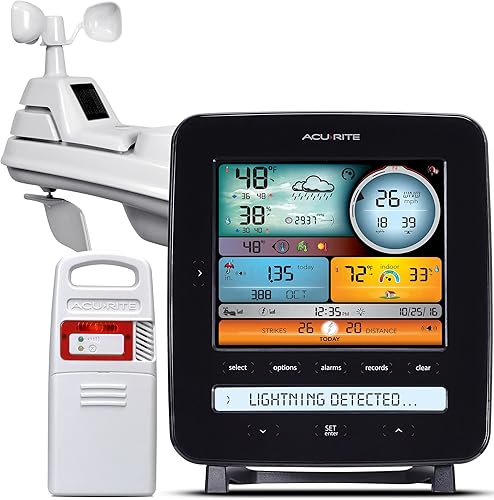
AcuRite Iris: Best for lightning alerts
- Lightning distance estimate and strike counts
- Over 50 information points
- Auto-dimming color display
- Wireless outdoor sensor
This AcuRite Iris focuses on local readings and lightning information, with a color display that tracks strike totals and weather records. Solar power isn't specified.
Pros
- Lightning distance estimate and counts
- Pressure and rainfall history
- Auto-dimming display
Cons
- Solar power isn't specified
- No Wi-Fi reporting details
This AcuRite Iris is the specialist pick for lightning information. Its display estimates the distance to lightning-producing storms and tracks strike totals, alongside temperature, humidity, wind and rainfall readings.
AcuRite describes a color screen with auto-dimming brightness, programmable alerts and a weather ticker. It also tracks pressure trends and historical rainfall and lightning records.
Solar power isn't specified for this model, so don't assume it has the same solar details mentioned for another Iris model. Pick it when lightning monitoring matters more than confirmed solar assistance.
AcuRite Iris: Best for simple color-screen monitoring
- Wireless outdoor sensor
- Over 55 weather data points
- Color LCD with adjustable dimmer
- 12-hour personalized forecast
This Iris setup provides local wireless readings and a color-screen console. Solar power isn't specified, so it's best for buyers without a firm solar requirement.
Pros
- Large color display
- Tracks wind, rain, temperature and humidity
- Wireless outdoor sensor
Cons
- Solar power isn't specified
- No app or Wi-Fi reporting details
This Iris model suits buyers who want a color-screen station for local weather readings. Its wireless outdoor sensor reports temperature, humidity, wind speed and direction, barometric pressure and rainfall.
The console displays more than 55 data points and includes an adjustable dimmer. Its forecast uses elevation and barometric pressure data.
Solar power and Wi-Fi reporting aren't specified for this model. Choose it for local monitoring if those features aren't essential, and confirm power requirements before planning a solar installation.
VEVOR 7-in-1 Wi-Fi Weather Station with APP: Best for app access and battery charging
- Solar-powered outdoor sensor
- Supports NiMH battery charging
- Smart Life app
- 2.4 GHz Wi-Fi required
VEVOR pairs a solar-powered outdoor sensor with battery support and Smart Life app access. The indoor adapter must stay plugged in to connect to Wi-Fi and sync the date.
Pros
- Solar panel and battery support
- Smart Life app access
- Rain, wind and sunlight readings
Cons
- Wi-Fi is 2.4 GHz only
- Indoor adapter must remain plugged in for Wi-Fi
VEVOR pairs a solar-powered outdoor sensor with battery support and Smart Life app access. The sensor monitors temperature, humidity, rainfall, wind, sunlight and other weather information.
The app can show and store readings over 2.4 GHz Wi-Fi. VEVOR says the indoor adapter must remain plugged in for Wi-Fi connection and date syncing, so the outdoor solar panel doesn't make the entire setup independent of household power.
A 7.5 in display gives you a local way to view conditions. The stated wireless transmission distance is up to 492 ft, with a note to avoid some interference sources and metal fences.
Choose VEVOR if you want app access plus a solar-assisted outdoor sensor. Confirm that 2.4 GHz Wi-Fi is available where you plan to install the console.
Sainlogic 5G&2.4G WiFi Weather Station: Best for dual-band Wi-Fi
- 5 GHz and 2.4 GHz Wi-Fi
- 443 ft stated wireless range in open areas
- Indoor and outdoor weather readings
- Two years of local data storage
Sainlogic offers Wi-Fi access, local data storage and several weather readings. Solar power isn't specified, so consider it when connectivity and stored history matter more than solar operation.
Pros
- Supports 5 GHz and 2.4 GHz Wi-Fi
- Stores up to two years locally
- Excel data export
Cons
- Solar power isn't specified
- Display details aren't specified
Sainlogic's 5G&2.4G WiFi Weather Station stands out for dual-band Wi-Fi and stored weather history. It tracks indoor and outdoor temperature and humidity, pressure, wind, rainfall and other conditions.
It supports up to two years of local data storage and Excel export. Its wireless sensor range is stated as up to 443 ft in open areas.
Solar power isn't specified, so this is a connectivity-focused alternative rather than a confirmed solar weather station. Choose it when remote data access and stored history matter more than solar support.
Sainlogic 12-in-1 Wireless Weather Station with Rain: Best for solar-assisted rain tracking
- Solar energy with battery backup
- Rainfall tracking
- Wireless outdoor transmission
- 6.5 in display
This Sainlogic pairs solar energy and battery backup with rainfall, wind and temperature readings. It has a local display and no Wi-Fi.
Pros
- Solar energy with battery backup
- Rainfall tracking and manual calibration
- Large display with adjustable backlight
Cons
- No Wi-Fi
- Backup batteries aren't included
This Sainlogic station combines solar energy with battery backup and local weather measurements. It tracks rainfall, wind speed and direction, temperature, humidity, pressure, dew point and perceived temperature.
The 6.5 in display has a three-level adjustable backlight. Its wireless connection sends readings to the console, but it has no Wi-Fi.
Choose it if you want solar-assisted outdoor monitoring and rainfall tracking with a local console. Skip it if you need to view data remotely through an app.
Ambient Weather WS-2000 Smart Weather Station: Best for a detailed color console
- Solar panel charges sensor-array super capacitor
- Optional battery backup
- TFT color console
- Wi-Fi weather publishing
The WS-2000 outdoor array uses a solar panel to charge its super capacitor, with optional battery backup. Its console shows wind, rain, UV and solar radiation, and can publish weather data over Wi-Fi.
Pros
- Solar-assisted outdoor sensor array
- Color console with multiple data views
- Wi-Fi publishing option
Cons
- Backup batteries aren't included
- Indoor sensor is optional and sold separately
The Ambient Weather WS-2000 offers solar-assisted outdoor sensing with a detailed color console. The sensor array's solar panel charges a super capacitor, and optional battery backup is available.
The array measures wind, rainfall, temperature, humidity, UV and solar radiation. The console can publish data over Wi-Fi and displays calculated information such as dew point and feels-like temperature.
The indoor sensor is optional and sold separately. Choose the WS-2000 if its console and Wi-Fi publishing suit your setup, and check which indoor readings you need before buying.
WeatherFlow Tempest Weather Station with Built-in Wind: Best for a no-display solar sensor
- Solar-powered outdoor sensor
- No moving parts
- Wireless transmission
- App and Alexa enabled
Tempest uses a solar-powered outdoor sensor with wireless reporting and no dedicated display. Choose it if app access fits your routine and you don't need a console at home.
Pros
- Solar-powered sensor
- No moving parts
- App and Alexa enabled
Cons
- No display
- Readings are accessed through connected services
Tempest is the solar-powered option for buyers who prefer app access over a console. Its outdoor sensor has no moving parts and monitors temperature, humidity, pressure, wind, dew point, solar radiation, UV, lightning and rainfall.
The sensor transmits wirelessly and works with app and Alexa services. With no display, you'll need a connected device to check readings.
Choose Tempest if you want a solar-powered sensor and don't need an indoor screen. Consider a console-based option if you want weather data visible in a shared room.
What should you check before buying a solar weather station?
Check the outdoor sensor's power source, backup method and console power needs before comparing extra features. Solar support can apply to one part of the system while the rest still needs an adapter or batteries.
Confirm whether backup batteries are included, what type they use and whether the system can run when sunlight is limited. Then check how the sensor reports to the console and whether the console needs a constant power connection for Wi-Fi.
Does a solar power weather station need Wi-Fi?
No, solar power and Wi-Fi are separate features. The Sainlogic 12-in-1 uses solar energy and wireless sensor transmission but doesn't include Wi-Fi, while VEVOR combines solar support with app access over 2.4 GHz Wi-Fi.
If you want remote access, check for an app or online reporting feature by name. Our guide to the best Wi-Fi weather stations compares stations by connected features.
How should you place the outdoor sensor?
Mount the sensor where it can collect outdoor readings and send them to its console without avoidable obstructions. Follow the station's mounting instructions, and account for the solar panel's access to daylight.
The Ambient WS-2902 array uses a pole mounting bracket, and its wireless signal may be affected by solid metal, earth or ground. Check the stated range against your yard and the walls between sensor and console.
Is a solar powered weather station always wireless?
No. Solar describes how a sensor gets energy, while wireless describes how readings travel.
A station can use a solar panel outdoors and a separate wireless connection to send data to a console or app.
For more detail on signal and console choices, compare our best wireless weather stations guide. Also check whether the sensor's wireless link is local only or supports remote access through Wi-Fi.
Which solar powered weather station should you choose?
Choose the AcuRite Iris with Weather Underground sharing for the highest score in this roundup, though its solar panel power arrangement isn't specified. The Ambient WS-2902 is the next pick, with a clearly described solar-assisted array, Wi-Fi and a color console.
Pick VEVOR for solar sensor support with Smart Life app access, Sainlogic 12-in-1 for solar-assisted rain monitoring without Wi-Fi, or Tempest if you prefer a no-display app system. Start with what a weather station console does if you're deciding whether you need an indoor screen, and read whether a home weather station can predict weather to understand what local forecasts can tell you.
Our top 3 picks at a glance
-
1
-
2
Best for solar-assisted Wi-Fi reporting
Ambient Weather WS-2902 Wi-Fi Smart Weather Station
9.6/10 our score
See it on Amazon -
3
Frequently asked questions
What does solar powered mean for a weather station?
Solar powered usually describes the outdoor sensor or array, not every part of the system. The Ambient Weather WS-2902 uses a solar panel to charge a super capacitor, with optional battery backup.
Check the console's power source separately, since it may still need an adapter or batteries.
Do solar weather stations work on cloudy days?
Some solar-assisted sensors include battery backup. VEVOR describes batteries taking over at night or in cloudy weather, while Ambient Weather describes optional backup batteries.
Check whether backup batteries are included and what type the system requires.
Can a solar weather station send data to a phone?
Yes, if its reporting system supports Wi-Fi or an app. VEVOR supports Smart Life app access over 2.4 GHz Wi-Fi, and Tempest offers app access.
A solar-powered sensor alone doesn't mean the station can send readings remotely, so check connectivity and console requirements.
Do solar weather stations measure rainfall?
Some do. The Ambient WS-2902, VEVOR 7-in-1, Sainlogic 12-in-1 and Tempest include rainfall monitoring in their described features.
If rain totals are your main reason for buying, compare the gauge details and see our guide to solar powered weather stations with rain gauges.
Does solar power mean a station needs no batteries?
No. Solar-assisted systems may use batteries as backup, and some require them for other parts of the setup.
The Ambient WS-2902 and WS-2000 describe optional battery backup for the outdoor array.
Review the power needs for both the sensor and console, and see what batteries an AcuRite weather station should use.