What Is PM2.5 on an Air Quality Monitor?
PM2.5 is fine airborne particulate matter with a diameter of 2.5 micrometers or less. An air quality monitor reports its concentration in the air, often in micrograms per cubic meter (µg/m³).
On this page (8 sections)
- What does PM2.5 mean on an air quality monitor?
- What can raise PM2.5 indoors?
- How should you read a PM2.5 number?
- What is the difference between PM2.5 and CO2?
- What should you look for in a PM2.5 monitor?
- Can a PM2.5 monitor and purifier work together?
- What does PM2.5 not tell you?
- How can you use a PM2.5 reading at home?
PM2.5 is fine airborne particulate matter 2.5 micrometers in diameter or smaller. An air quality monitor shows its concentration in the sampled air, commonly in micrograms per cubic meter (µg/m³).
The number can rise when activities or outdoor conditions add fine particles to a room. It helps you track changes, but the reading alone does not identify the particle source or assess health.
What does PM2.5 mean on an air quality monitor?
PM2.5 describes particle size, not a specific substance. The term refers to particles no larger than 2.5 micrometers across.
Monitors typically display a concentration, often in µg/m³. A higher number means more fine particulate matter is present in the air sampled by the device.
PM2.5 is different from a general air quality score, which may combine several readings into one indicator. Check which measures a device reports, such as PM2.5, temperature, humidity, or gases.
What can raise PM2.5 indoors?
Smoke, cooking, and particles brought in from outside can raise indoor PM2.5. The monitor shows a change in particle concentration, but it usually cannot identify its source.
Cooking can send fine particles into the air, especially when food is fried or burned. Smoke from cigarettes, candles, fireplaces, or outdoor fires can also contribute.
Dust and other particles may enter through open doors, windows, or ventilation.
A sudden increase is a cue to consider what recently changed in or around the room. For smoke-related monitoring, see our guides to air quality monitors for smoke and air quality monitors for cigarette smoke.
How should you read a PM2.5 number?
Use the number to compare conditions over time, and consult public health guidance to interpret a level. A monitor reading depends on where the device sits, airflow in the room, and the sensor.
Watch whether readings rise during a particular activity and fall after the source stops or ventilation changes. Place the monitor where air can reach its sensor, following the device instructions.
One reading does not describe every room in your home. If you want a device that focuses on particle readings, compare the options in our best PM2.5 air monitor guide.
Does PM2.5 tell you how much dust is in a room?
PM2.5 can reflect some fine airborne dust, but it does not measure all dust. Larger dust particles may settle quickly or fall outside the size range the monitor reports.
If dust is your main concern, look at placement and repeat readings under similar conditions. Our guide to air quality monitors for dust covers devices for that use.
What is the difference between PM2.5 and CO2?
PM2.5 measures fine particles, while CO2 monitors measure carbon dioxide gas. The readings answer different questions, so a PM2.5 number cannot tell you the room's CO2 level.
The Amazon Smart Air Quality Monitor tracks PM2.5, volatile organic compounds (VOCs), carbon monoxide (CO), humidity, and temperature, and works with Alexa.
If you need a separate CO2 device, start with our guide on how to monitor CO2 levels or compare NDIR CO2 monitors. For a device that is easier to carry between rooms, see portable CO2 monitors.
What should you look for in a PM2.5 monitor?
Choose a monitor based on the readings, display, and data access you need. Some show PM2.5 alone, while others pair it with temperature, humidity, or additional air measures.
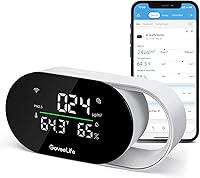
The GoveeLife Smart Air Quality Monitor with PM2.5 measures PM2.5, temperature, and humidity. It has an LED display, a two-second correction data feature, Bluetooth or Wi-Fi monitoring, and app data graphs; it needs a power source.
Check whether the monitor needs Wi-Fi, an app, or a constant power connection before choosing it. Our air quality monitor buying guide explains the main features to compare.
Can a PM2.5 monitor and purifier work together?
A monitor can help you see whether the particle reading changes while a purifier runs. It does not prove that a purifier removes every particle or that the air is safe.
The TeraAire Air Purifiers for Home has a PM2.5 display and infrared sensor, plus a HEPA filtration system. Its listed uses include lint, hair, pet dander, fine airborne pollutants, and smoke particles.
Follow the purifier's instructions for filter care and room use. Compare the monitor's reading over time, and consider other conditions such as ventilation and nearby particle sources.
What does PM2.5 not tell you?
A PM2.5 reading does not identify the particles, measure every pollutant, or provide a medical assessment. It is one piece of information about the air at the sensor's location.
A low PM2.5 number does not mean that every other air concern is absent. A device may need separate sensors to detect gases or other conditions, so check its measured factors before relying on it for a specific need.
How can you use a PM2.5 reading at home?
Use PM2.5 as a way to notice changes in fine particle concentration. If readings rise, consider recent cooking, smoke, outdoor air, or other activity, then follow relevant public health and device guidance.
Choose a monitor that measures the factors you care about, and place it where its sensor can sample room air. PM2.5 reports fine particle concentration, while a device's other sensors and public guidance provide more context.
Frequently asked questions
What does PM2.5 mean on an air quality monitor?
PM2.5 means airborne particles with a diameter of 2.5 micrometers or less. A monitor estimates or measures their concentration in the air, commonly shown in micrograms per cubic meter.
The reading can change when activities or outdoor conditions add particles to the room.
Is a higher PM2.5 reading worse?
A higher PM2.5 concentration means more fine particles are present in the sampled air. Compare readings over time and follow guidance from a public health authority for interpreting levels, since a single monitor reading does not diagnose a health condition.
Does a PM2.5 monitor detect carbon dioxide?
No, PM2.5 and carbon dioxide are different measurements. A PM2.5 monitor tracks fine particles, while a CO2 monitor measures carbon dioxide concentration.
Some devices track both, but check the monitor's sensors before choosing one.
Can an air purifier lower a PM2.5 reading?
An air purifier with particle filtration may reduce airborne particles as it circulates room air, but results depend on the room, airflow, filter, and particle source. A monitor can help you see whether readings change after you run the purifier.