How to Monitor CO2 Levels
Place a CO2 monitor where people spend time, away from windows, vents, and direct breath. Watch readings over time and use sustained rises as a cue to check ventilation, then see whether levels fall.
On this page (5 sections)
To monitor CO2 levels indoors, place a CO2 monitor where people spend time, away from windows, vents, and direct breath. Watch readings over time and use sustained rises as a cue to check ventilation, then see whether levels fall.
A reading is most useful when you know what was happening in the room. Note how many people were present, whether a window or door was open, and whether a fan or ventilation system was running.
Where should you place a CO2 monitor?
Put the monitor in the occupied part of the room, near breathing height, with clear space around its sensor. Keep it away from windows, exterior doors, supply vents, and spots where someone might breathe directly onto it.
A device placed right beside a window may reflect incoming air more than conditions across the room. A sensor beside a vent may also respond to the airflow there, so choose a spot people use regularly instead.
If you want to compare rooms, move the monitor and leave it in each location long enough to observe typical use. Avoid comparing a quick reading in one room with a reading taken after hours in another.
An air quality monitor buying guide can help you check which measurements matter for your goal. Some devices track CO2, while others focus on particles or other indoor conditions.
How do you read CO2 trends?
Look for repeated patterns and changes after ventilation, rather than treating one number as a full picture of the room. Write down the time, occupancy, and ventilation changes beside readings if your device doesn't keep a history.
A rise while a room is occupied, followed by a decline after fresh air enters, can help you understand how the space responds. If readings stay raised, check whether windows, doors, or the building's ventilation can provide more outdoor air.
CO2 readings can help you assess ventilation, but they do not identify every indoor air concern. A low CO2 reading doesn't tell you whether particles, gases, or other pollutants are present.
For general background, the EPA's indoor air quality guidance discusses ventilation as one part of managing indoor air. Use applicable building or public health guidance when a specific limit or action is needed.
What features help you monitor CO2?
Choose a device that measures CO2 directly and makes readings easy to review where you need them. A clear display can help with quick checks, while stored readings or an app can make daily patterns easier to compare.
The SAF Aranet4 measures CO2, temperature, relative humidity, and atmospheric pressure. Its e-ink display uses color coding and a prominent CO2 number, and its app can show up to 90 days of historical data.
If you want an at-home option, compare a CO2 monitor for home with the room and display features you prefer. For audible alerts, see CO2 monitors with alarms.
Does a general air quality monitor measure CO2?
Check the measurements before relying on a monitor for CO2. A display with an air quality score or color indicator doesn't necessarily include carbon dioxide.
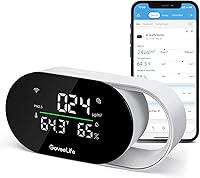
The GoveeLife Smart Air Quality Monitor with PM2.5 measures PM2.5, temperature, and humidity. It also has an LED display and can store and export data, but it does not measure CO2.
Use it to follow those three factors, not as a replacement for a CO2 monitor. Its readings can add context to an indoor air routine, but they won't show whether CO2 rises when a room fills.
Can a Wi-Fi air quality monitor replace a CO2 meter?
Only if it measures CO2. Wireless access, phone notifications, or a color-coded air quality score do not by themselves indicate carbon dioxide.
The Amazon Smart Air Quality Monitor tracks PM2.5, VOCs, carbon monoxide, humidity, and temperature. It can show an air quality score in the Alexa app and send notifications for poor air quality, but it does not measure CO2.
If you want remote access to readings, compare CO2 monitors with Wi-Fi. Check the specific measurements first, since smart features don't guarantee CO2 monitoring.
How can you use readings to improve ventilation?
Treat a steady increase as a reason to check airflow and room use. If practical, open a window or door, or adjust ventilation according to your building's controls, then observe whether the reading changes.
Use the same monitor in the same spot while you compare before-and-after readings. Make one change at a time when possible, so you can see which action appears to affect the trend.
For a shared workspace, consistent placement can help people compare readings across the day. A CO2 monitor for an office may suit a team that wants a visible display or shared review of room patterns.
How do you choose a CO2 monitor for your needs?
Start with the room and the way you'll use the readings. A dedicated CO2 display suits quick checks, while an app can help you review changes over time.
If you want a large, easy-to-read number, compare a CO2 monitor with a display. For sensor technology, review NDIR CO2 monitors; for checking different rooms, consider a portable CO2 monitor.
Pick a dedicated CO2 monitor if you need CO2 readings. Choose a broader air quality monitor for other measurements only after confirming which factors it tracks.
For monitoring CO2 levels, keep the device in a representative spot, note room conditions, and use trends to guide ventilation checks.
Frequently asked questions
Where should I put a CO2 monitor?
Place it in a room where people spend time, at a height that represents the breathing zone, and away from open windows, doors, vents, and a person's direct breath. Keep it clear of obstructions and follow the device instructions.
For a useful comparison, leave it in the same spot while you track changes.
What is a normal CO2 level indoors?
Indoor readings vary with outdoor air, room size, occupancy, and ventilation, so one number cannot describe every room. Compare readings over time and use sustained increases as a prompt to check airflow.
Follow local health or building guidance for decisions that require a specific limit.
How long should I monitor CO2?
Monitor during the times and activities you want to understand, such as a full workday or an evening with several people in a room. Keep the device in one location and note occupancy, window changes, and ventilation.
Repeated patterns are more useful than a single reading.
Do all air quality monitors measure CO2?
No. Some measure particles, temperature, or humidity without measuring carbon dioxide.
Check that CO2 is named as a measured factor before buying.
A monitor that shows PM2.5 or a general air quality score cannot substitute for a CO2 reading.